Important!
- The underlay roof is installed hanging over the rafters, not on solid wooden substrates.
- To achieve optimal sealing at each mounted batten, the TECCA Batten Sealing Tape should be placed between the battens and the underlay before fixing and nailing. Screwed battens also improve the seal against the underlay.
- Unless otherwise stated, the latest recommendations in AMA-Hus (JSC.6) apply.
- The roof's surface layer determines the minimum slope for the underlay, but it must always be at least 14° (1:4).
- T-Diff Pro is a so-called diffusion-open underlay roof where optimal function requires airtight installation from roof to ridge. An air gap between the underlying insulation and the underlay roof is not required!
- Gently load the surface and immediately seal and repair any damage. Minor damages are repaired with repair and sealing tape recommended by TECCA (T-Flex Outdoor). For larger damage, replace the entire fabric between the rafters with a new piece.
- T-Diff Pro meets the requirement for puncture resistance when all fastening, such as nailing and battening
(nail and support battens) of the fabric, is ready! Maximum c-distance from rafters is 1200 mm.
- No depressions or backfalls should form in the underlay roof during fastening and fixing.
- Rolls should be stored on a flat and dry surface and protected from sunlight (UV) and precipitation.
- During installation and colder weather (< +5°C), both adhesive tapes may need to be gently heated for optimal adhesion and pre-heating of the rolls beforehand.
- For optimal adhesion of the adhesive tape and during all installation occasions, the surface should be dry, clean, and free from grease.
- After installation, the underlayment must be completely enclosed and protected from sunlight (UV-). The maximum exposure time (UV-) before top covering is four months.
- Always cover with the surface layer as soon as possible to avoid impact from bad weather.
- TECCA T-Butyl splice tape is an approved splicing aid and sealant.
- The use of TECCA Distance for underlay roofing is recommended centered under at least every other load-bearing batten (approximately 2 pcs/sqm roof) for better fixation of the sheet and its overlap between the rafters.
1.
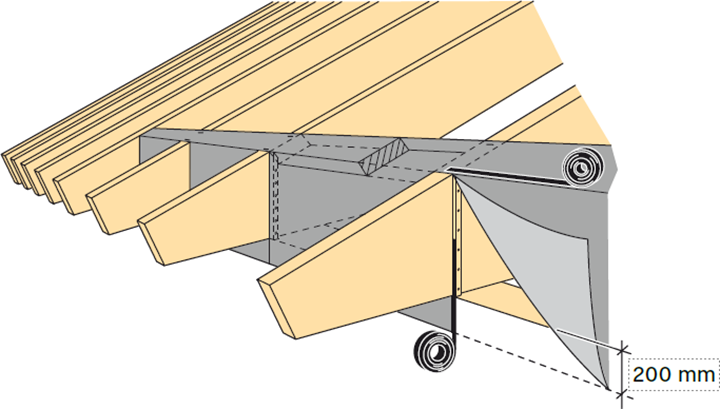
First arrange the transition between the wall's wind protection layer vertically up between each rafter to finish on its top side (corresponds to the underside of the covering underlay roof). This is done with a slit/cut sheet of the underlay roof, nogging/beam e.g. 45 x 70 mm (support between rafters) as well as nail battens e.g. 22 x 45 mm and double-sided T-Butyl Joint Tape (for support and sealing).
Cut a strip with a width of 20 cm (overlapping down over the wall's wind protection) + height up to the top edge of the rafter + extra allowance for support rule, e.g., 70 mm.
Install length-adjusted support beams between each rafter so that the outside of the outer wall forms a vertical line up and meets the upper outer edge of the beam. Attach with the top side at the same slope as the roof pitch.
The battens are attached cut to size on both sides against the rafter in the same plane and vertical line. Roll out the cut sheet along the upper edge of all support beams. Fasten (nail/staple) on the top side against these. Stretch the sheet down along the roof slope and cut/slot for each rafter. Fold down and fasten/seal with T-Butyl Joint Tape against the battens all the way from bottom to top.
On the top side nearest the edge, a joint tape is applied along the entire support as a seal against the upcoming underlay roof. The protective film on the joint tape can be kept on its outside to be finally removed when fastening and sealing occur. Consider desirable good ventilation during the construction period!
The connection to the underside of the underlay roof should always be arranged first. Sealing downwards with the flaps can be postponed to temporarily use the eaves as ventilation openings. For further improved ventilation, temporary openings are also made during construction, for example, on gables.
2. Start general assembly
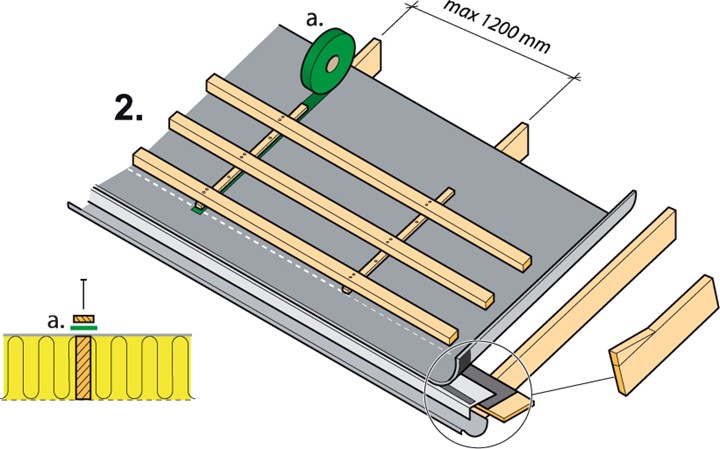
Coverage is done horizontally starting at the eaves. First, attach custom wedges to the ends of the rafters. Then, an eaves board (Construction Plywood or clapboard wood panel) with a drip edge above and as a drip edge (with a strip of flashing underneath). The height of the wedge and the thickness of the eaves board should together correspond to the thickness of the battens and a roof tile. The eaves board should be wide enough to reach about 10 mm below the lowest batten and edge.
If the outer roof consists of profiled sheet metal or as an alternative, wedges can be omitted and the installation can be done at the same slope all the way to the edge of the eaves. The finish is done with a footboard between the rafters and battens. The lowest batten can be standing on edge or lying down depending on the type of outer roof. After this, a gutter with gutter hooks may be installed.
The underlay roof should be rolled out with the printed side facing up, stretched well about 20 mm from the bending edge of the base plate. Attach sparingly but as needed with staples (12.9 x 10 mm, c-distance 50 mm or 16.5 x 19 mm, c-distance 100 mm) to the roof truss. Cut manageable lengths for handling on the roof and add an extra +100 mm at each gable truss. The lower edge of the sheet is fastened downwards in the base plate with the prefabricated adhesive edge. The underlay roof is fixed by shorter battens (min 22 x 45 mm) and with termination before the overlap line.
To achieve tightness under each counter batten, TECCA Batten Sealing Tape (a.) is adhered over each rafter against the membrane. Lengths according to the counter battens. Then fasten the counter battens over the tape to the rafter with hot-dip galvanized wire nails 63 x 2.8 mm at 300 mm intervals. The load-bearing battens (min 45 x 70 mm) are then fastened with 2 x hot-dip galvanized nails 100 x 34 mm at each rafter attachment point.
3. Subsequent panels
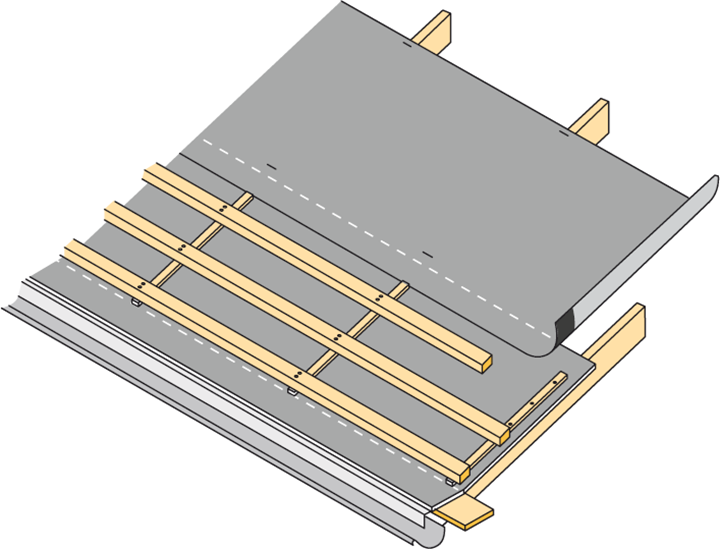
Roll out the next strip with an overlap aligned to the correct dashed line on the lower strip.
At a 14° - 26° slope, a total overlap of 200 mm is required, and at a ≥27° slope, the minimum overlap is 150 mm.
Adjust the sheet evenly and attach it to the rafter with staples. Stretch and smooth the overlap while removing the protective film from the adhesive edge of the overlapping sheet. Press the two sheets together carefully. Complete the stapling.
Continued fixing in the roof truss is done with battens (up to the next line for overlap).
4.
Where cross joints are necessary, execute them well. Joints and overlaps may only occur over the roof truss with an additional 100 mm flap on each side.
Fold down the lower edge of the sheet and fasten it to the rafter with hot-dip galvanized roofing felt nails at least 20 x 2.8 mm and a c-spacing of 80 mm.
T-Butyl Joint Tape is installed over the roof truss and on the lower membrane as a seal.
The upper and overlapping sheet is attached over and pressed firmly into the joint tape (T-Butyl).
Above, an additional seal is installed, Batten Sealing Tape from Tecca. The tape is adhered to the fabric and provided with a finishing pressing batten above. Counter battens according to general installation.
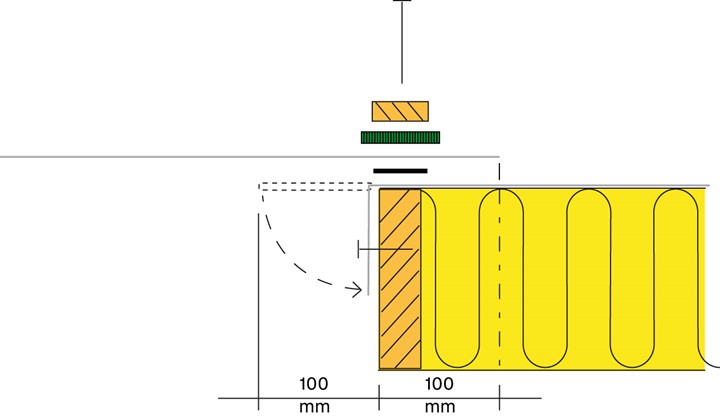
5. Headboard
The strips (100 mm) at the gable truss are folded down on the outside and fastened with hot-dip galvanized roofing felt nails at least 20 x 2.8 mm and c-spacing 80 mm.
As a protective transition between the gable peak and the underlay roof, a strip of the same material (approximately 300 mm) is installed. The strip should be extended from and over the nearest lower cladding board on the gable peak at least 200 mm over the underlay roof.
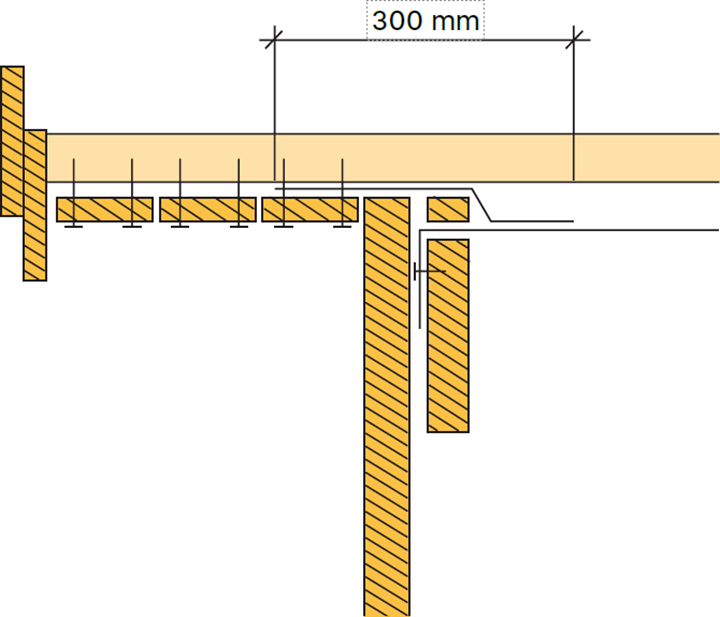
6. Nock
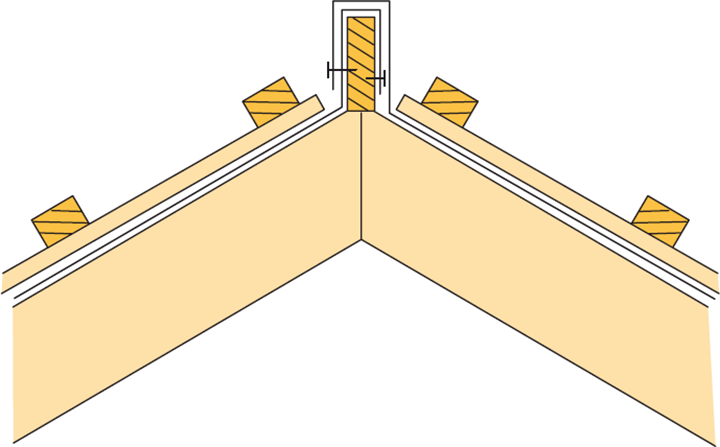
The ridge solution should be tight (not ventilated) and have overlapping seams between the sheet flap of one roof side and the other.
The strips should cover both sides of the ridge board and be finally fastened with hot-dip galvanized roofing felt nails at least 20 x 2.8 mm, c-distance 160 mm.
The ventilation under the roof tiles must not deteriorate and is expected to function according to standard practice!
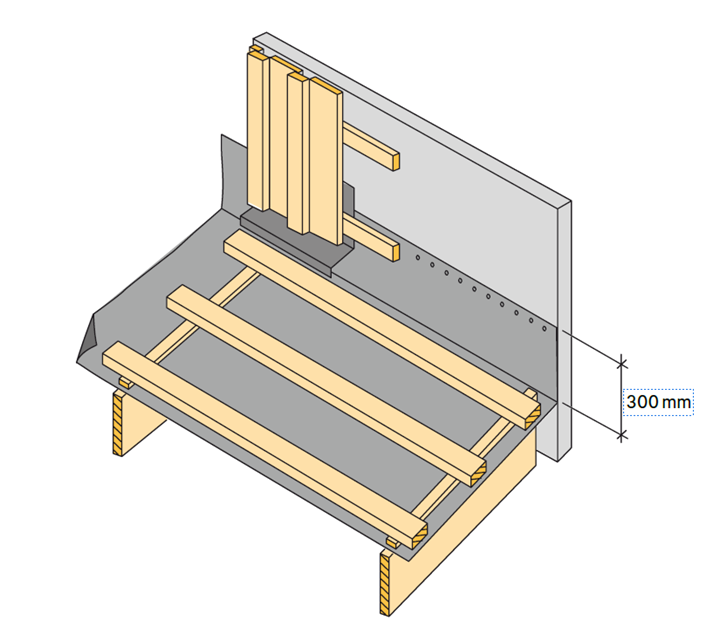
7.
The underlay is pulled up at least 300 mm and fastened with hot-dip galvanized roofing felt nails at least 20 x 2.8 mm, c-spacing 80 mm.
8. Implementation larger
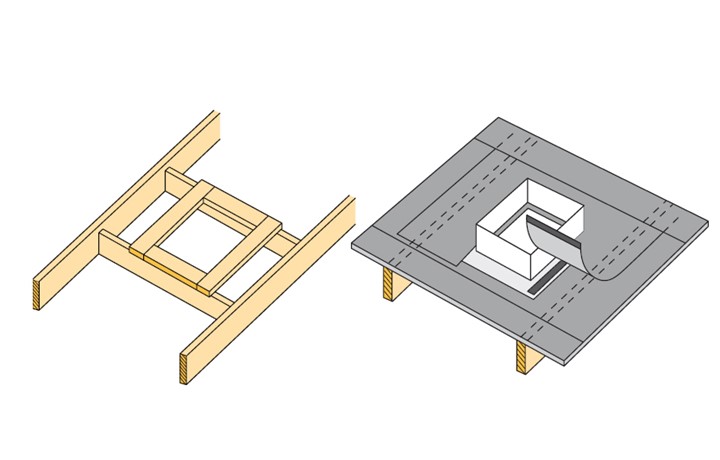
Openings such as ventilation ducts or chimneys first require bridging between the roof beams for support and stabilization.
An underflashing with a 150 mm wide collar/base is also required. Install the underlay roof over it and mark the position of the pass-through.
An extra sheet length is placed over the entire truss bay. The sheet is slid under the upper overlapping sheet. It is easily fastened under the overlap and sealed afterwards if necessary.
Fold up the extra panel and arrange the pass-through in the lower panel.
Install under the fitting. Cut out a flap in the extra overlapping sheet from the top edge of the under fitting and straight down on both sides. Fold down. Attach this overlapping sheet with the upcoming battens and double-sided T-Butyl seam tape at unfixed edges down to the substrate.
9. Implementation less
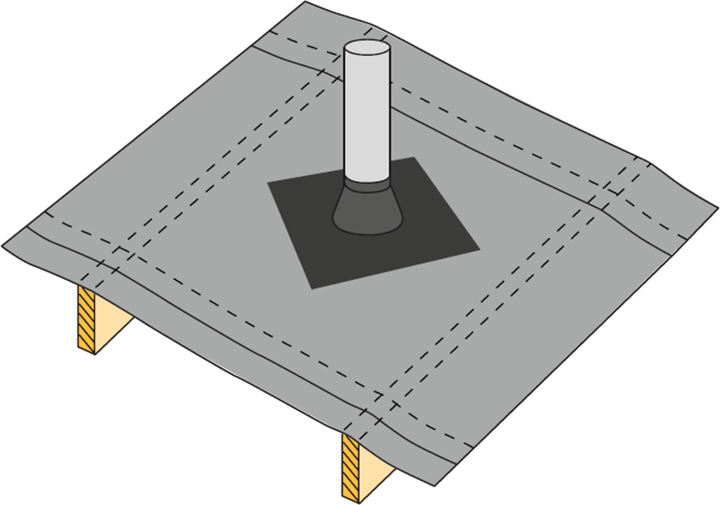
Pass-throughs such as smaller round air ducts (drains, etc.) are executed with self-adhesive collars (T-Stos Butyl) in the correct dimension.
Mark the center of the hole and make a slightly smaller cut cross in the underlay roof than the pipe diameter.
The rubber boot should be pulled over the pipe and the adhesive collar pressed firmly against the surface with one corner angled up towards the ridge.
10. Valley gutter
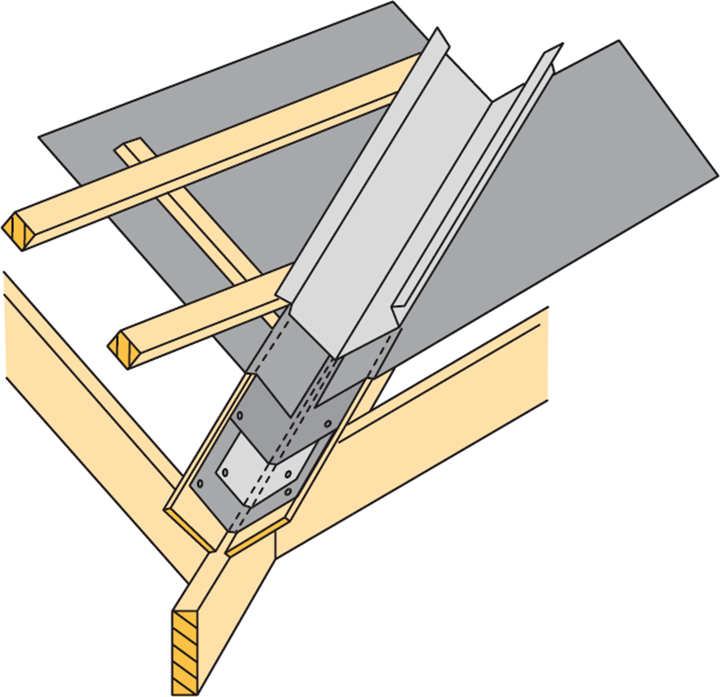
The valley gutter should have a stable wooden base and for fixation, a metal underlay. The underlay is equipped with a condensation-protective strip (e.g., T-Roof Multi Strip). A strip of the underlay T-Diff Pro, a central strip, is installed above the underlay, covering the entire width of the base and the underlay as well as its entire length.
Let each roof side's sheets be drawn over this central sheet with overlap towards the middle. Secure with double-sided T-Butyl seam tape if necessary.
Finally, install the gutter plate over. Finish down towards the base plate as previously described.
11. Alternative mounting on existing nailable surface
Renovation of older fixed roof underlay or outer roof (e.g., shingle roof) can be performed with T-Diff Pro underlay as described below. Always assess the suitability of the older underlay for covering in terms of load-bearing capacity or previous moisture-related damage.
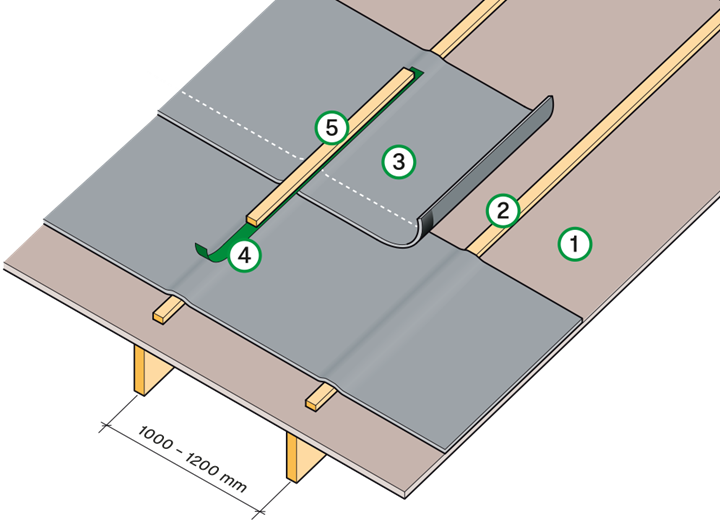
The existing fixed roof (1) is first equipped with battens (2) of at least dimension 22 x 45 mm with a c-distance of 1000-1200 mm, which can be likened to the upper edges of roof trusses. To consider the load-bearing capacity of the new battened outer roof, place the battens directly over the old underlying roof beams. Be careful and level the battens against the old substrate and align if necessary.
Ensure that the surface is free from sharp protruding details such as nails or similar irregularities. Then, install T-Diff Pro (3) exactly according to the installation instructions (as hanging). In this case, the fabric should hang down between these battens and can rest on the underlying roof surface. The overlap is glued with the adhesive edge. Sagging is good and a prerequisite for good water drainage between the battens.
On surfaces where the canvas rests against the base, careful support and foot pressure can be applied. When the canvas is hanging and the base cannot support it, no pressure should be applied.
Above the battens and the fabric, a Batten Sealing Tape (4) is installed. The tape should be adhered downwards towards the fabric. Above the Batten Sealing Tape, a nail batten (5) with dimensions of at least 22 x 45 mm is placed and fastened.
Installation of the counter battens completes the battening across the two underlying battens in the direction of the roof slope. The dimension of the counter battens should be at least 45 x 70 mm.
Instructions for fastenings and endings at the eaves, see point 2. General assembly.
Note that the new layer of T-Diff Pro is diffusion-open, but it does not affect the diffusion openness of the underlying existing layers. In combined layers without ventilation, such as various wood substrates or other materials, the sum of the materials' diffusion openness applies to assess the entire substrate. The existing substrate (1) may need to be ventilated underneath if the combined layers are deemed too sluggish or to ensure the possibility of removing any potentially harmful underlying moisture.