TopTite 3 GREEN
Self-adhesive surface felt with SBS elastomer asphalt 7 m x 1 m
Important!
- Store and transport upright. Should be covered when stored outdoors. Must not be stacked.
- At temperatures below +10°C, store the roofing felt at room temperature for 1-2 days before roofing.
- When laying on old roofing felt, damages/blisters should be repaired for the best result. Cut away, dry, and possibly repair with sealing adhesive K-36 or alternatively adhesive and sealing compound T-Fix.
- For the best results during assembly, always ensure precision at joints, endings, or pass-throughs. These are the areas with the greatest risk for potential future moisture problems.
Verktyg
Utility knife, hammer, measuring tape, steel spatula, and spray gun. In cold weather (below +10 °C), a heat gun for activating the self-adhesive surfaces.
Monteringsförhållanden
During installation, both material and outdoor temperatures should be at least +10 °C. The TopTite 3° Green roofing should not be installed at temperatures below +5 °C. Installation should be done in dry weather without the threat of rain. If installation must be temporarily halted, ensure that moisture from any potential rain cannot get under the roofing. To avoid color differences, always unroll the paper rolls in the same direction.
The base should be stable (should not flex under normal load), smooth, and dry. It can consist of air-dried clapboard wood panel boards (width approx. 95 mm), full-edged boards (width approx. 100 mm), or moisture-resistant construction board. Minimum tongue thickness 23 mm. For more, see AMA Hus 14. The risk of the boards or panels swelling should be considered by leaving sufficiently large gaps between them.
Installation
TopTite 3° Green should be laid so that no reverse seams occur anywhere. The sheets can be laid either across the ridge (vertically) or along the ridge (horizontally). We recommend vertical laying, so that the sheets can be better tensioned and secured more safely. On an old felt roof, TopTite 3° Green should be laid in the same direction as the old felt and so that the longitudinal seams are not placed on top of the old longitudinal seams. The roofing nails used should go through the roof decking. (Short nails will eventually pop up due to variations in humidity.)

1. Ränndalar
First, install any valley gutters with roofing underlay. Nail the edges with 20 cm nail spacing on the substrate. Then install the base flashings according to the instructions in point 2 (base flashing can also be an option for gable edges). Next, lay a 50 cm wide TopTite sheet in the valley gutter along its length. Nail the sheet with 10 cm nail spacing on the substrate and glue the lower end with K-36 Sealant on the base flashing. The sheets from the roof slope are placed with a 15 cm overlap on the valley sheet, and the short sides are cut according to the valley. The overlap is glued with K-36 Sealant. Spread the glue in a layer of about 1 mm (e.g., with a 4 x 4 mm notched trowel, hold the trowel at a 45° angle). Press the surfaces together carefully to avoid air entrapment and press firmly until the glue seeps out of the joint. Finally, smooth the glue that has seeped out with a trowel.


2. Fotplåtar
The eaves' base plates are mounted on the clapboard wood panel and wooden substrate, alternatively (always in Sweden) on the roofing underlay or when re-laying on the old roofing felt. Nail the plate in a zigzag line with felt nails into the substrate at approximately 10 cm intervals. Let the joints overlap by about 5 cm and nail through both plates.
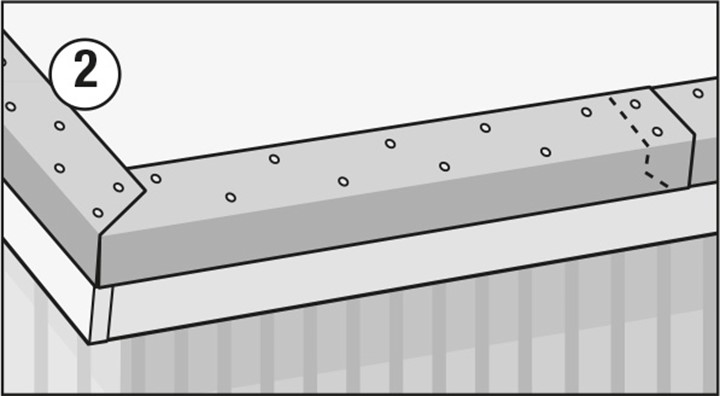
3. Takfot, vågrät montering
Place the TopTite 3° Green edge parallel to the eaves so that the adhesive edge on the underside of the felt will lie on the drip edge. To avoid creasing, the bottom strip should also be laid straight, even if the eaves are not completely straight.
Note! Remove the protective film from the top side of the sheet only after the next sheet has been aligned in place.
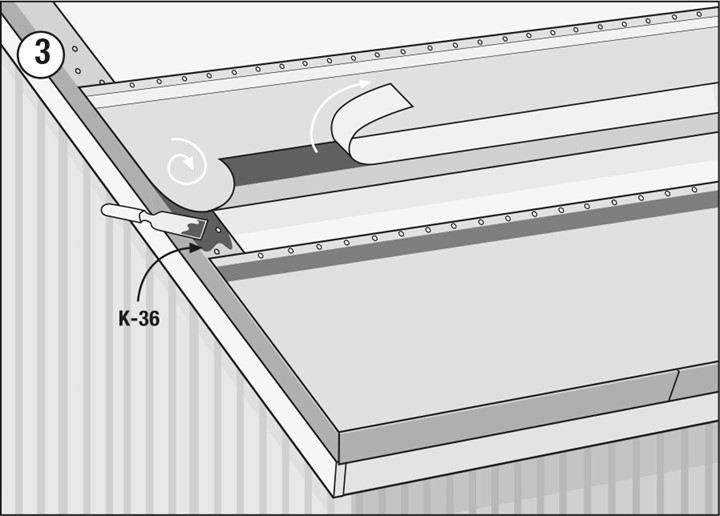
3. Takfot, lodrät montering
Lay TopTite 3° Green parallel to the gable edge, so that the adhesive edge on the underside of the felt will lie on the gable edge and any base flashing. If base flashing is not used, TopTite 3° Green should extend over the gable edge so that the felt edge hangs 1-2 cm lower than the gable edge. The felt is glued to the gable edge and nailed at the outer edge. When the installation has reached the other gable edge, the edge of the last felt strip is glued with K-36 Sealant over a width of 15 cm to the base flashing or substrate. At the eaves, the felt ends are glued with K-36 Sealant to the base flashing. In vertical installation, it is equally important that the first strip is installed straight, even if the gable edge is not completely straight.
Note! Remove the protective film from the top side of the sheet only after the next sheet has been aligned in place.
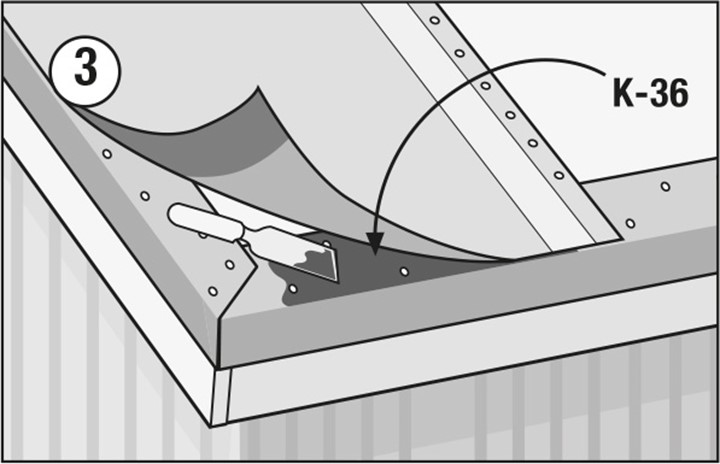
4. Inriktning och -fästning
The edge is nailed in the middle of the fastening edge with a 10 cm nail distance. Always be careful to stretch the sheet sufficiently. The protective film on the underside is removed and the adhesive surface is pressed onto the base plate without creasing. The following sheet is aligned with the seam overlap corresponding to the width of the adhesive surface and nailed to the substrate in the fastening edge in the same way as the first sheet. Fold up the seam overlap and remove the protective film from both sheets and press the joint together firmly. Always ensure that the sheet is stretched and straight. Continue in the same way to the ridge (or the other gable edge). After proper installation, no nail heads should be visible. Instead of roofing nails, a combination of screw + washer can be used. The center distance for these in the middle zone is 50 cm and 25 cm in corners and edge zones (about 1m from edges). Read more on the supplier's website (www.katepalsverige.se or www.teccaworld.com)


5.
TopTite 3° Green is joined with a 15 cm overlap. Cut a piece diagonally in each corner of the paper and nail the end of the paper that is underneath to the substrate. Spread the adhesive in a layer of about 1 mm (e.g., with a 4 x 4 mm notched trowel, hold the trowel at a 45° angle) and press the overlapping paper firmly into the adhesive. Remove any adhesive that seeps out from under the edge. The sealing adhesive dries to final hardness in about two weeks.
Note! Remove the protective film from the top side of the sheet only after the next sheet has been aligned in place.

6. Gavelkanten
The gable edge is covered with a foot plate or with a gable board and gable plate. The image shows different options. When a regular foot plate is used, the ends of the TopTite 3° Green felt are glued with Sealant to the plate to a width of 10 cm (for horizontal installation).

7. Genomföringar och skorsten
When the installation of the roofing felt has reached the level of the upper edge of the chimney or another larger pass-through, cut the TopTite 3° Green sheets according to drawing 7 and glue them in sequence with Sealant to about 15 cm width on the chimney and the felt from the roof slope (overlap 15 cm). The angle at the base is broken, for example, with a triangular strip. Always cover the actual penetration with a separate TopTite 3° Green sheet that reaches at least 30 cm up and 15 cm out on the roof. Nail the raised felt at the upper edge in the chimney's joints. Carefully seal the corners with Sealant and finally protect the chimney with metal.


8.
For pipes or equivalent structural parts that pass through the roof, elastic pass-through collars with at least 15 cm wide flanges are used. Place the collar in position and nail the flanges to the substrate. Cut holes in the TopTite 3° Green paper as large as the lower circumference of the collar and glue the paper underneath completely to the flange with Sealant. Attach the sheets according to the instructions in point 5 (joint)

9. Effektivare ventilering
If more efficient ventilation is needed in the space under the roof, a negative pressure ventilator is installed on or near the roof ridge. During installation, follow the instructions in point 8 (pass-through stand).
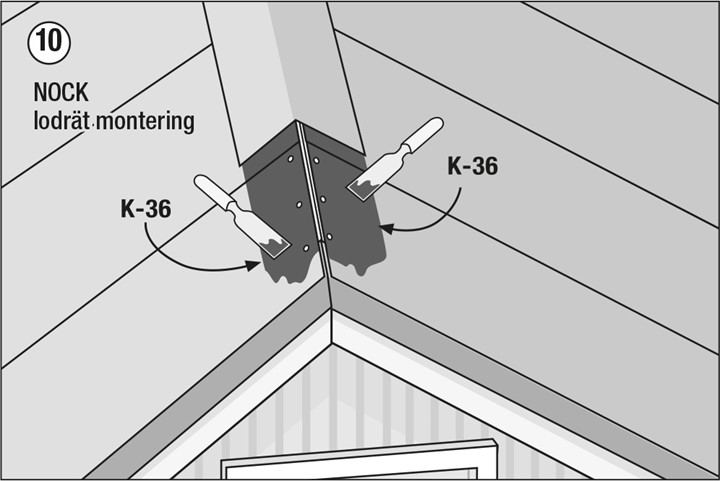
10. Nock montering
When the first roof side is covered with TopTite, the felt is slightly extended over the ridge and nailed to the substrate. The sheets from the opposite roof side are extended about 20 cm over the ridge and glued with Sealant to the underlying roofing felt with a width of 15 cm. Any visible adhesive edge on the top side is trimmed off.

Finjustering av taktäckningen
Finally, check the areas most at risk of leakage and seal them with Sealant:
- The corners of the chimney and other pass-throughs
- Joints and paper edges
- Edges of the joint seams
Finally, install the sheet metal fittings.