Viktigt!
- Fuktspärrsmattan skall lagras innan montering så att UV-strålning (solljus) undviks. Monterad och återfylld grund skall hela produkten vara dold. Detta för att garantera åldringsbeständigheten.
- Följ monteringsanvisningen noga och tillse att erforderlig dränering i botten skapas.
- Tänk på att lägre monteringstemperaturer kan påverka systemets olika komponenter och försämra elasticitet och hållfasthet samt vidhäftning. Fuktspärren monteras bäst den varma delen av året.
- Torr väderlek och uttorkat/rengjort underlag vid montering bidrar till ett bra resultat.
- Vid montaget beakta kraftigt solljus och fuktskyddsmattans rörelser efter större temperaturskillnader.
- Använd endast kompatibla och rekommenderade tillbehör.
1. Förberedelser
Borsta väggen ren från lös smuts, knacka bort eventuella ojämnheter och laga trasiga fogar samt större skador på väggen. Om väggen saknar puts på den nedre delen så putsas denna med cementbruk som underlag för ett grundmursmembran.
Om bottenplattan sticker ut utanför källarväggen fyller du vinkeln mellan vägg och platta med cementbruk så att en snedfasad kant bildas (hålkäl).
Om du misstänker att det finns befintliga fuktskador rekommenderar vi att du kontaktar en fuktsakkunnig. Det är viktigt att en utredning genomförs så att sanerings- och åtgärdsförslag görs på ett riktigt sätt.
Tänk på att lägre monteringstemperaturer (<+5°C) kan påverka systemets olika komponenter och försämra elasticitet och hållfasthet. Torktider och häftbarhet försämras påtagligt vid kallare temperaturer. Undvik vintermontering. Flytmembranet är frostkänsligt eller det självhäftande Klistermembranet fäster också sämre!
2. Dränering
Oavsett vilken typ av fuktskydd du väljer för källarväggen, krävs en väl fungerande dränering för att resultatet ska bli bra.
Om det är problem med att få tillräcklig lutning - kontakta kommunens tekniska kontor, eventuellt kan dräneringen anslutas till spillvattenledningen.
3. Fuktspärrssystemet utan isolering
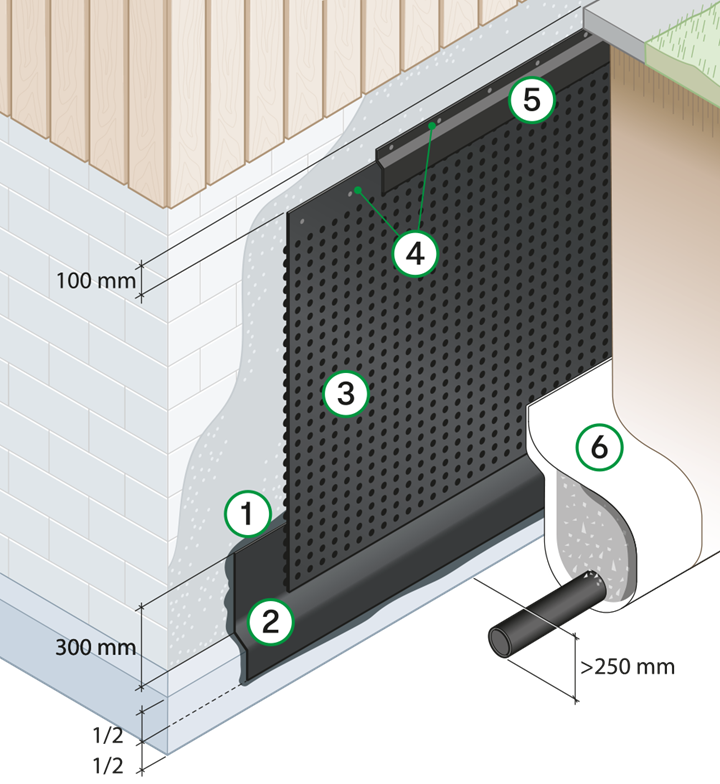
1. Primer K-80 (för 2.1 eller 2.2)
2. Grundmursmembran (3 alternativ)
- 2.1 Klistermembran BituTite (0,5m)
- 2.2 Grundmursmembran svetsbart
- 2.3 Flytmembran
3. T-Block Remade fuktspärrsmatta
4. Spik och bricka
5. Kantlist
6. Geotextil Geo-T N2
Dräneringen i botten fylls med minst 100 mm singel 8-16. Vi rekommenderar att Tecca geotextil Geo-T N2 (6.) används runt dräneringsmaterialet för att förhindra att fint material täpper till dräneringsledningen.
För självklistrande Klistermembran BituTite (2.1) stryk Primer K-80 från halva bottenplattan och ca 300 mm upp på väggen. Efter torktid applicera det självklistrande Klistermembranet så att det täcker den behandlade ytan. Skarvar skall överlappas med minst 5 cm överlapp. Tryckförsegla alla ytor noggrant (ex med handroller). Använd värmepistol, försiktigt, vid lägre temperaturer(<+1O°C) eller vid behov.
För Grundmursmembran svetsbart (2.2) montera med hetluft mot den torra primerbehandlade muren (får ej vara kladdig och ohärdad). Se monteringsanvinsing.
För Flytmembran (2.3) (är frostkänslig vid lagring och applicering), stryk i två skikt (1 kg/kvm/strykning) från halva bottenplattan och ca 300 mm upp på väggen. Låt torka mellan strykningarna. Se monteringsanvisning på emballaget.
OBS! För högre komfort och fuktsäkrare lösning i källaren se Fuktspärrssystem med isolering (pkt 5.).
4. Montering av fuktsspärrsmattan T-Block Remade
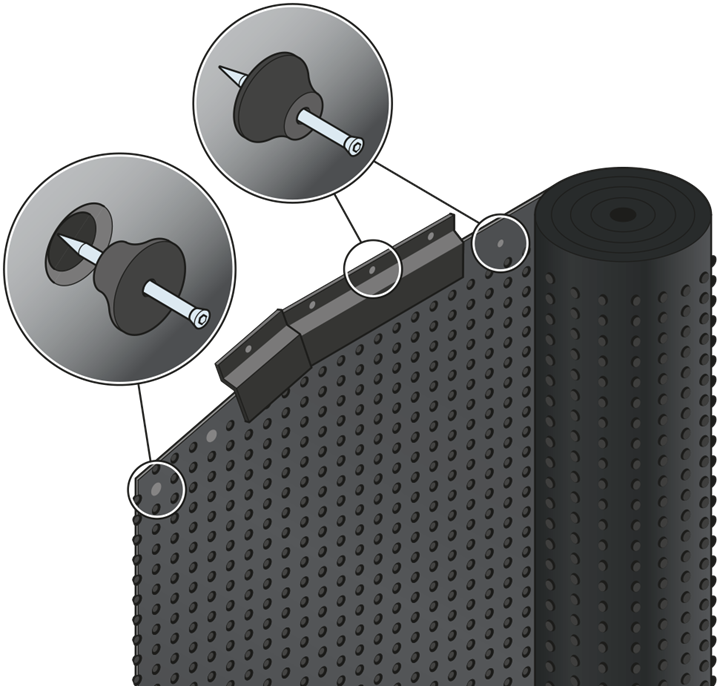
Rulla ut fuktspärren med distanserna (knopparna) in mot väggen och med den plana kanten uppåt. Mattans nedre del avslutas ca 50 mm ovanför hålkälet. Fäst upp mattan i övre kant med spik, bricka och avsluta med kantlist. Spikavstånd är 250 mm i mattan och erforderligt maximalt 400 mm i kantlist. Nederkanten fixeras mot grundmuren under återfyllnaden.
Använd Teccas spik och bricka för betongmur eller kombinera Teccas bricka med varmgalvaniserad trådspik (längd ca 75 mm) för lättbetong.
Vid ojämn (lutande) marklinje skärs den plana delen i toppen bort och kantlist fästs i överkant för att förhindra att jord och smuts faller ner i luftspalten.
När mattan monteras med isolering utanpå skall den plana överkanten inte förseglas med kantlist utan enligt pkt 5. med en vattenavledning (membran eller plåtbleck) från grundmur över mattan och isoleringen.
Vid skarvningar läggs mattan omlott horisontellt med minst 100 mm och vertikalt 500 mm. Undvik att skarva närmare hörn än 1500 mm. Toppen och övre kant på mattan justeras så att den slutar ca 100 mm under färdig marknivå, och spikavstånd 250 mm.
OBS! Vid genomföringar i fuktspärren var noga med tätningar runt hålet! Använd avsedd stos (T-Stos) eller tätningstejp (Flexseal-T)!
5. Fuktspärrssystemet med isolering
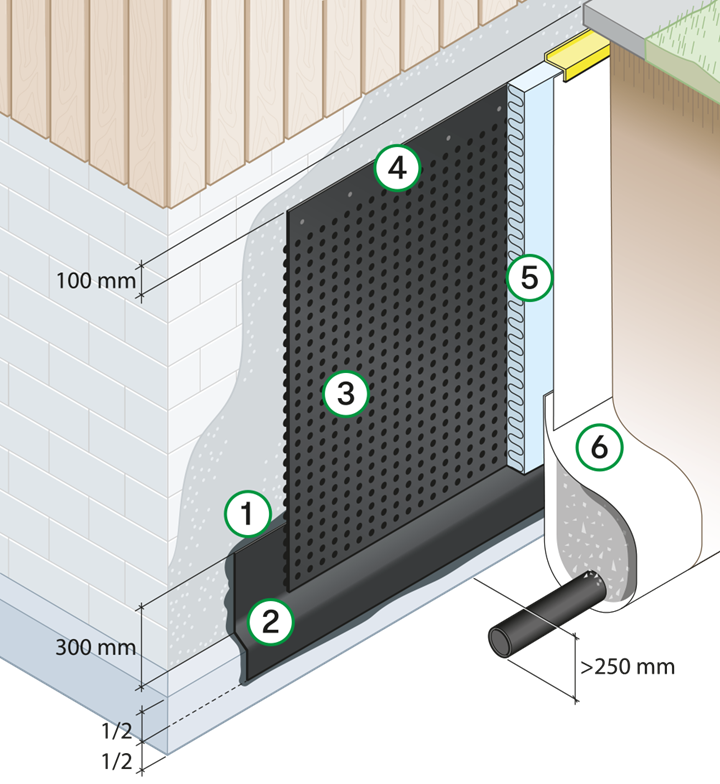
1. Primer K-80 (för 2.1 eller 2.2)
2. Grundmursmembran (3 alternativ)
- 2.1 Klistermembran BituTite (0,5m) -Se pkt 3!
- 2.2 Grundmursmembran svetsbart -Se pkt 3!
- 2.3 Flytmembran -Se pkt 3!
3. T-Block Remade fuktspärrsmatta
4. Spik och bricka
5. Isolering (markskiva av XPS-foam, ej från Tecca)
6. Geotextil Geo-T N2
Om du vill minska värmeförlusterna genom källarytterväggen eller höja väggens temperatur för att få en torrare vägg och höja komforten, kan man efter att ha monterat fuktspärrsmattan isolera med lämplig markisolering (5.).
Skivorna ställs mot fuktspärren och hålls på plats genom att återfyllningen sker efterhand som isoleringen monteras. Förse isoleringens utsida med Geotextil (6.). Anslut med dräneringsbäddens geotextil i botten samt infäst den i toppen av skivorna.
Toppen förses med en vattenavledning från grundmuren (kraftigt vattentätt membran eller plåtbleck).
6. Återfyllnad
Vid återfyllnaden kan i regel befintliga massor användas. Stora vassa stenar som kan skada fuktspärrsmattan, eller isoleringen, tas bort. Det är också viktigt vid återfyllnad att nederdelen av mattan trycks in ordentligt mot grundmuren, eftersom ingen spikning sker där.
Beakta risken för sättningar. Packa och komprimera väl, allt efter hand, som grundmuren återfylls.
Se till att erforderlig marklutning från grundsockeln skapas vid återfyllnaden. Minst lutningen motsvarande 5 cm/m och 3 m ut.
T-Block Remade fuktspärr grund
För insida källaryttervägg
1. Montering T-Block Remade källaryttervägg – insida
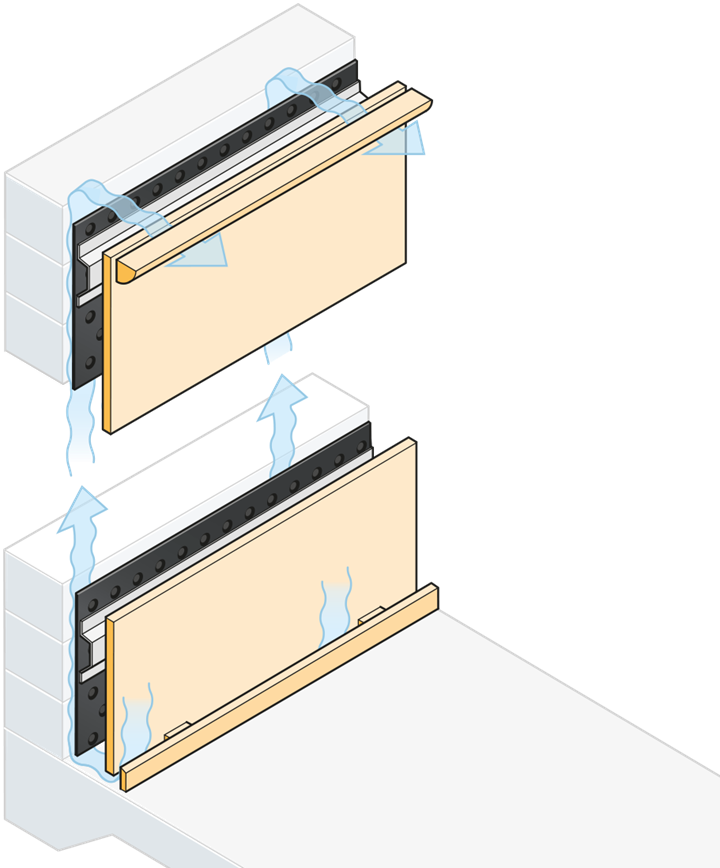
Källarytterväggen blir inte torrare av att man monterar en fuktspärr på dess insida. Däremot kan denna placering vara ett alternativ om du tänker montera ett fuktkänsligt material i källarväggen (ex gips eller träpanel). Kontakta gärna en fuktsakkunnig om du är osäker.
Fuktspärren monteras på väggen och fästs med spik och bricka i kuporna. Mattans överkant skall skäras bort så att dess kanter är öppna runt om. Utanpå denna monteras sedan den fuktkänsliga panelen eller skrivmaterialet. Här är det viktigt att lämna luft spalter både vid tak och golv. Plåtreglar är det bästa alternativet men används träreglar så bör du sätta en distans, exempelvis klossar av hårdplast, för att undvika direktkontakt mellan träreglarna och golvet.
Luft skall kunna ta sig in i botten av väggen, in mellan fuktspärren och grundmur samt ut vid öppning vid taket. Den invändigt exponerade gipsen eller träpanelen skall avslutas innan golv och tak för att ge möjlighet till ventilation.