Important!
- The moisture barrier mat should be stored before installation to avoid UV radiation (sunlight). Once installed and backfilled, the entire product should be concealed. This is to ensure aging resistance.
- Follow the assembly instructions carefully and ensure that the necessary drainage at the bottom is created.
- Note that lower installation temperatures can affect the system's various components and impair elasticity, strength, and adhesion. The moisture barrier is best installed during the warmer part of the year.
- Dry weather and dried/cleaned surface during installation contribute to a good result.
- During installation, consider strong sunlight and the movements of the moisture protection mat after significant temperature differences.
- Use only compatible and recommended accessories.
1. Förberedelser
Brush the wall clean of loose dirt, knock away any irregularities, and repair damaged joints as well as larger damages on the wall. If the wall lacks plaster on the lower part, plaster it with cement mortar as a base for a foundation membrane.
If the base plate protrudes outside the basement wall, fill the angle between the wall and the plate with cement mortar so that a beveled edge is formed (cove).
If you suspect there are existing moisture damages, we recommend contacting a moisture expert. It is important that an investigation is conducted so that remediation and action proposals are made correctly.
Note that lower installation temperatures (<+5°C) can affect the system's various components and reduce elasticity and strength. Drying times and adhesion are significantly impaired at colder temperatures. Avoid winter installation. The floating membrane is sensitive to frost, and the self-adhesive adhesive membrane also adheres less effectively!
2. Dränering
No matter what type of moisture protection you choose for the basement wall, a well-functioning drainage system is required for a good result.
Om det är problem med att få tillräcklig lutning - kontakta kommunens tekniska kontor, eventuellt kan dräneringen anslutas till spillvattenledningen.
3. Fuktspärrssystemet utan isolering
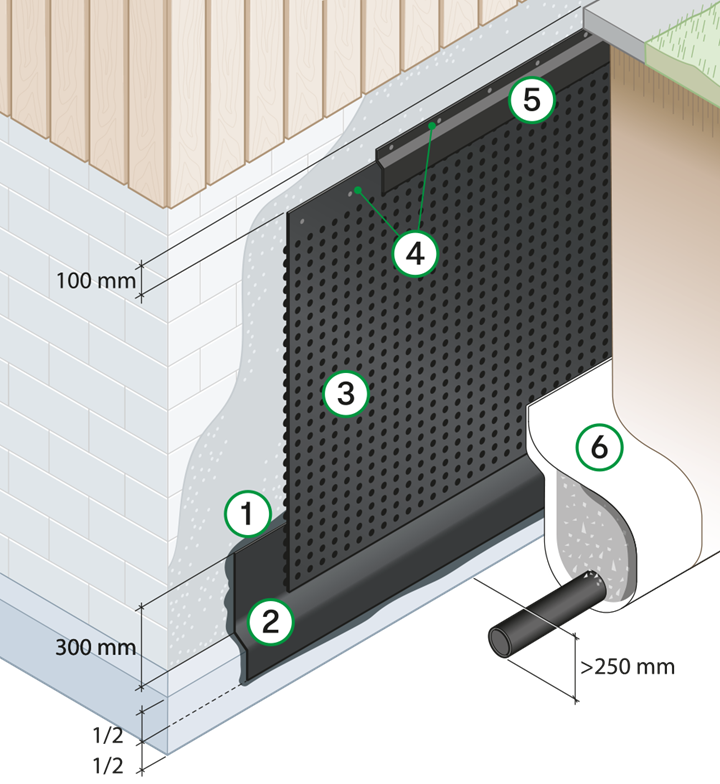
1. Primer K-80 (for 2.1 or 2.2)
2. Foundation Wall Membrane (3 alternativ)
- 2.1 Adhesive Membrane BituTite (0.5m)
- 2.2 Grundmursmembran svetsbart
- 2.3 Floating membrane
3. T-Block Remade moisture barrier mat
4. Nail and plate
5. Edge strip
6. Geotextile Geo-T N2
The drainage at the bottom is filled with at least 100 mm of gravel 8-16. We recommend using Tecca geotextile Geo-T N2 (6.) around the drainage material to prevent fine material from clogging the drainage pipe.
For self-adhesive Membrane BituTite (2.1), apply Primer K-80 from halfway up the base plate and approximately 300 mm up the wall. After drying time, apply the self-adhesive Membrane so that it covers the treated surface. Joints should be overlapped with at least a 5 cm overlap. Press-seal all surfaces carefully (e.g., with a hand roller). Use a heat gun, carefully, at lower temperatures (<+10°C) or as needed.
For Weldable Foundation Wall Membrane (2.2), install with hot air against the dry primer-treated wall (must not be sticky and uncured). See installation instructions.
För Flytmembran (2.3) (är frostkänslig vid lagring och applicering), stryk i två skikt (1 kg/kvm/strykning) från halva bottenplattan och ca 300 mm upp på väggen. Låt torka mellan strykningarna. Se monteringsanvisning på emballaget.
Note! For higher comfort and a more moisture-proof solution in the basement, see Moisture Barrier System with insulation (item 5).
4. Montering av fuktsspärrsmattan T-Block Remade
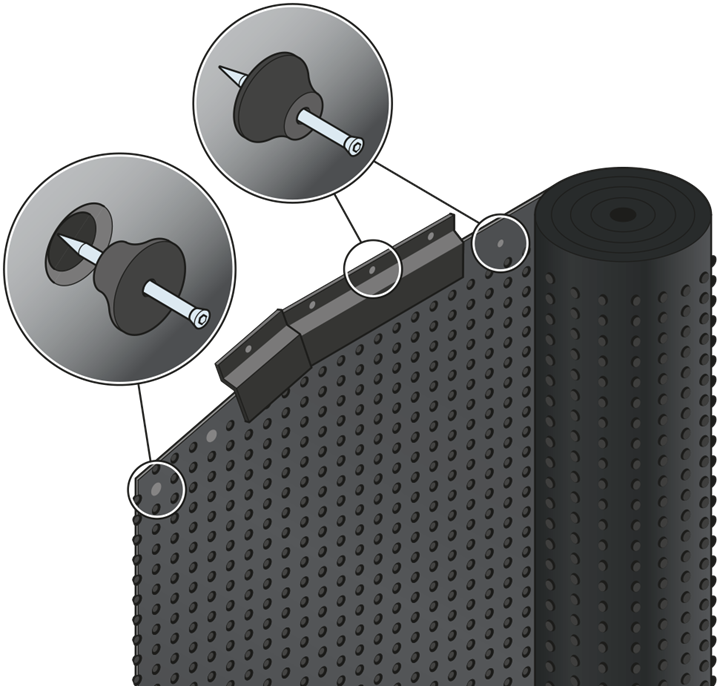
Roll out the moisture barrier with the spacers (knobs) facing the wall and with the flat edge upwards. The lower part of the mat ends approximately 50 mm above the cove. Secure the mat at the upper edge with nails, washers, and finish with an edge strip. The nail spacing is 250 mm in the mat and a maximum of 400 mm in the edge strip. The lower edge is fixed against the foundation wall during backfilling.
Använd Teccas spik och bricka för betongmur eller kombinera Teccas bricka med varmgalvaniserad trådspik (längd ca 75 mm) för lättbetong.
On uneven (sloping) ground line, the flat part at the top is cut away and an edge strip is attached at the top to prevent soil and dirt from falling into the air gap.
När mattan monteras med isolering utanpå skall den plana överkanten inte förseglas med kantlist utan enligt pkt 5. med en vattenavledning (membran eller plåtbleck) från grundmur över mattan och isoleringen.
When joining, the mat is overlapped horizontally by at least 100 mm and vertically by 500 mm. Avoid joining closer to corners than 1500 mm. The top and upper edge of the mat are adjusted so that it ends approximately 100 mm below the finished ground level, with a nail spacing of 250 mm.
NOTE! When making pass-through in the moisture barrier, be careful with the seals around the hole! Use the designated sleeve (T-Sleeve) or sealing tape (Flexseal-T)!
5. Fuktspärrssystemet med isolering
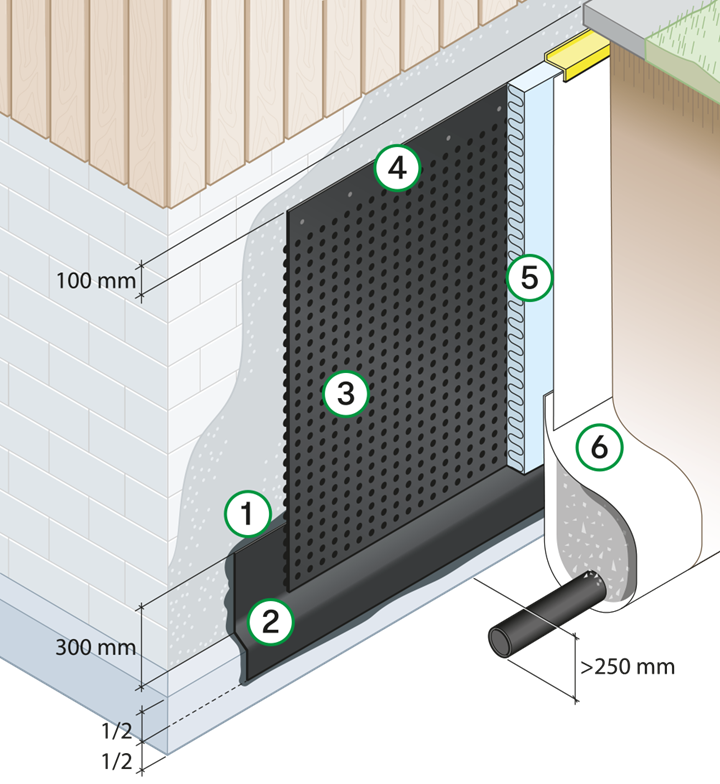
1. Primer K-80 (for 2.1 or 2.2)
2. Foundation Wall Membrane (3 alternativ)
- 2.1 Adhesive Membrane BituTite (0.5m) -See item 3!
- 2.2 Weldable foundation membrane -See item 3!
- 2.3 Floating Membrane -See item 3!
3. T-Block Remade moisture barrier mat
4. Nail and plate
5. Isolering (ground board of XPS foam, not from Tecca)
6. Geotextile Geo-T N2
If you want to reduce heat loss through the basement exterior wall or increase the wall's temperature to achieve a drier wall and improve comfort, you can insulate with suitable ground insulation after installing the moisture barrier mat (5.).
The boards are placed against the moisture barrier and held in place as the backfilling is done gradually while the insulation is installed. Cover the outside of the insulation with Geotextile (6.). Connect with the drainage bed's geotextile at the bottom and attach it to the top of the boards.
The top is equipped with a water drainage system from the foundation wall (heavy-duty waterproof membrane or metal flashing).
6. Återfyllnad
During backfilling, existing masses can generally be used. Large sharp stones that can damage the moisture barrier mat or insulation are removed. It is also important during backfilling that the lower part of the mat is pressed firmly against the foundation wall, as no nailing occurs there.
Consider the risk of subsidence. Pack and compress well, gradually, as the foundation wall is backfilled.
Se till att erforderlig marklutning från grundsockeln skapas vid återfyllnaden. Minst lutningen motsvarande 5 cm/m och 3 m ut.
T-Block Remade Moisture Barrier Base
For interior basement outer wall
1. Montering T-Block Remade källaryttervägg – insida
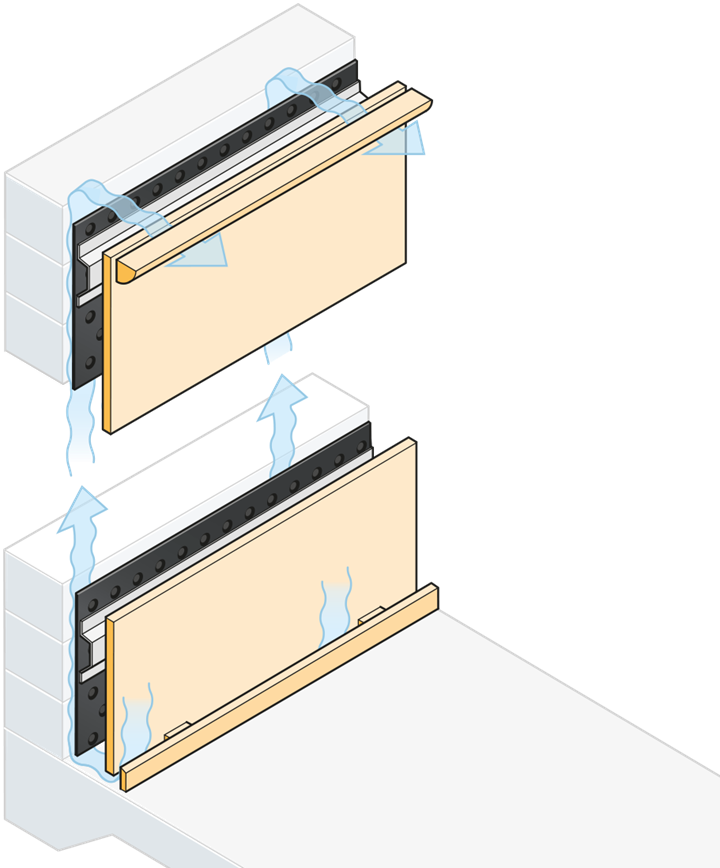
The exterior basement wall does not become drier by installing a moisture barrier on its inside. However, this placement can be an option if you plan to install a moisture-sensitive material in the basement wall (e.g., plasterboard or wood paneling). Feel free to contact a moisture expert if you are unsure.
The moisture barrier is mounted on the wall and fastened with nails and washers in the cups. The top edge of the mat should be cut away so that its edges are open all around. On top of this, the moisture-sensitive panel or writing material is then mounted. It is important to leave air gaps both at the roof and the floor. Metal studs are the best option, but if wooden studs are used, you should place a spacer, such as blocks of hard plastic, to avoid direct contact between the wooden studs and the floor.
Luft skall kunna ta sig in i botten av väggen, in mellan fuktspärren och grundmur samt ut vid öppning vid taket. Den invändigt exponerade gipsen eller träpanelen skall avslutas innan golv och tak för att ge möjlighet till ventilation.