Important!
- The product should not be combined with surface layers that are hot air mounted (welded).
- The surface must be smooth, clean, dry, free of frost and grease.
- Application should be done on a firm and fixed surface.
- The adhesive surface has aggressive adhesion under normal conditions! In cooler weather (< +10°C), there may sometimes be a need to improve the adhesion.
- Use a heat gun and gently warm the adhesive surface. Press the seam together carefully! At temperatures below +5°C, the product should be stored for at least 1 day in a warm storage.
- Note that primer is required when the product is used as a joint strip for roof cassettes. Teccas Liquid Membrane is recommended as a primer, and for installation temperatures below +5°C, Primer K-80 should be used.
- Carefully check the adhesion strength after installation. Consider adverse weather conditions and ensure temporary fixation of the assembly or protective covering until the permanent surface layer is installed!
- Be mindful to gently load the surface and immediately address any damage or incorrect/visible fastenings with roofing adhesive equivalent to T-Fix or Sealing Adhesive K-36.
- Always cover with the surface layer (tiles, sheet metal, etc.) as soon as possible to avoid exposure to sunlight and adverse weather conditions. During the construction period, the product can be exposed to sunlight for up to a maximum of 12 months. In the usage stage, the product should be completely enclosed and protected from sunlight.
- The rolls should be stored upright on a flat, dry surface
surface as well as protection from sun and precipitation.
1. Hantering
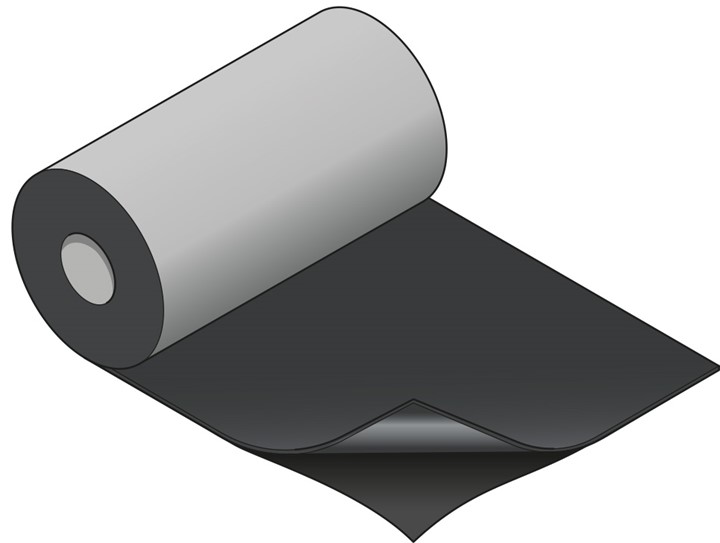
T-Roof Multi Strip finns i bredderna 330 mm respektive 500 mm. Ovansidan är försedd med en polyesterduk och undersidans butylhäftämne är skyddad av två skyddsfolier som avlägsnas vid montage. Materialet kan klippas med grov sax men skärs bäst med rakblads- eller mattkniv.
2. Montering som takfotsremsa (eller likvärdigt kondensskydd under plåtdetaljer)
Roll out T-Roof Multi Strip (2.) with the protective film facing down towards the wooden substrate (1.). Adjust to the appropriate length for installation and align straight. At the eaves, let the T-Roof Multi Strip extend over the outer edge of the last clapboard wood panel board by about 5 mm. Remove the protective film at the same pace as the strip is pressed evenly against the substrate. If necessary, the strip can be secured with sparse nailing of roofing felt nails to the substrate. Mechanically attach the eaves flashing (3.) over the T-Roof Multi Strip.
At the eaves, finish by installing the first strip of the underlayment (4.) over the eaves flashing so that it at least covers all visible nailing in the flashing.
NOTE! Fotplåten får inte vara belagd med PVC. Vid montage för plana plåttak kan med fördel klistersidan vändas uppåt. Så att skyddsfolien avlägsnas efter att fotplåten (3.) har monterats mot remsan med skyddsfolie. Den exponerade övre delen av skyddsfolien avlägsnas innan montaget av underlagstäckningen (4.). Tryck samman våderna!
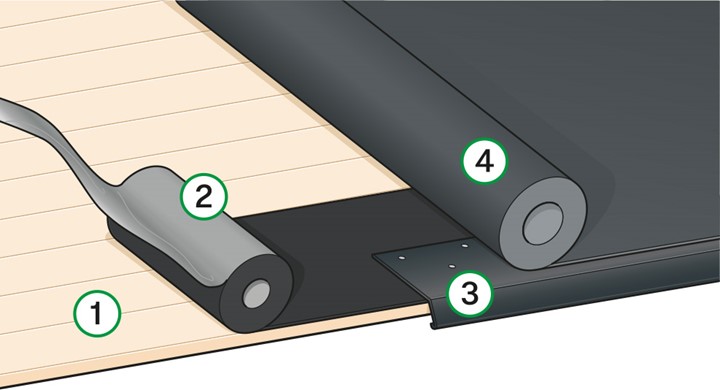
1. Wooden base
2. T-Roof Multi Strip
3. Eaves Flashing
4. Underlay
3. Montering som skarvremsa för takkasetter med läkt med taklutningar ≥14° (1:4)
The roof cassette left and right (1./2.) should be anchored securely (3.) according to the roof cassette supplier's instructions. Roll out the T-Roof Multi Strip tape (4.) with the protective film facing down. Adjust to the appropriate length for installation and align straight along the seam. Half the width of the tape on each cassette side.
Remove the protective film at the same pace as the strip is pressed evenly against the underlayment (6.). Finally, the outer edges of the T-Roof Multi Strip are clamped with the left and right battens (5.). The battens should be mechanically fastened with screws.
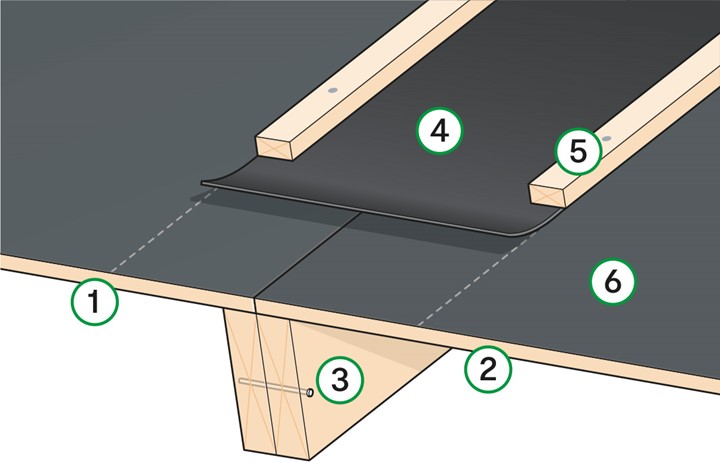
1. Roof cassette/wooden substrate
2. Roof cassette/wooden substrate
3. Fastening according to the instructions from the roof cassette supplier
4. T-Roof Multi Strip
5. Battens
6. Underlay
4. Montering som skarvremsa för takkasetter utan läkt med taklutningar ≥6° (1:10)
The roof cassettes and underlay (5.) should be pre-treated with primer (6.) on the top side of the meeting edges towards the joint (at least 200 mm/side) with Teccas Liquid Membrane or Primer K-80. One application/rolling is sufficient, then let it dry. This should be done in a frost-free, dry, and heated environment (preferably indoors). The left and right roof cassettes (1./2.) should be anchored securely (3.) according to the roof cassette supplier's instructions.
Roll out the T-Roof Multi Strip strip 4.) with the protective film facing down. Adjust to the appropriate length for installation and align straight along the seam. Half the width of the strip on each cassette side. Remove the protective film at the same pace as the strip is pressed evenly (steel roller recommended) against the surface.
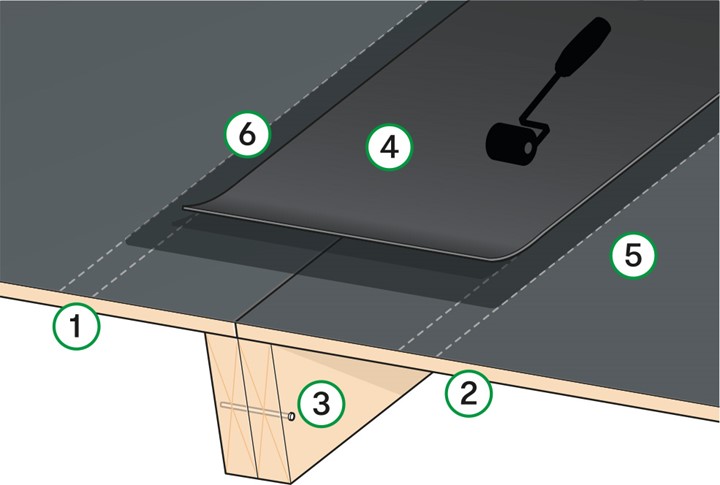
1. Roof cassette/wooden substrate
2. Roof cassette/wooden substrate
3. Fastening according to instructions from
the supplier of roof cassettes
4. T-Roof Multi Strip
5. Underlayment
6. Primer K-80 alternative
Liquid Membrane
5. Montering som ränndalsremsa (330 och 500 mm bredd) i vinkelränna
The bottom of the valley gutter is first fitted with a metal underlay (3.) for stabilization. A T-Roof Multi Strip (2.) 330 or 500 mm wide strip is then mounted centered in the valley gutter. The underlay is mechanically fastened down into the wooden substrate (1.).
At the top of the valley gutter, the T-Roof Multi Strip (4.) 500 mm wide valley strip is then installed. The strip is fastened/nail with roofing felt nails at the edges with a center distance of 60 mm.
For overlapping (150 mm) underlay coverage (5.) and from each roof side, adhesion (6.) is done with Tätklister K-36 or alternatively T-Fix with three strings (or at least 80 mm filling) on both edges. Press down the overlaps carefully.
Avoid cross joints of T-Roof Multi Strip in the valley gutter if possible. If jointing is necessary, overlap with the strip from above by at least 150 mm. Glue with Sealant K-36 or alternatively T-Fix with three strings (or fill the bottom 80 mm of the overlap). No mechanical fastening should be visible in the final result.
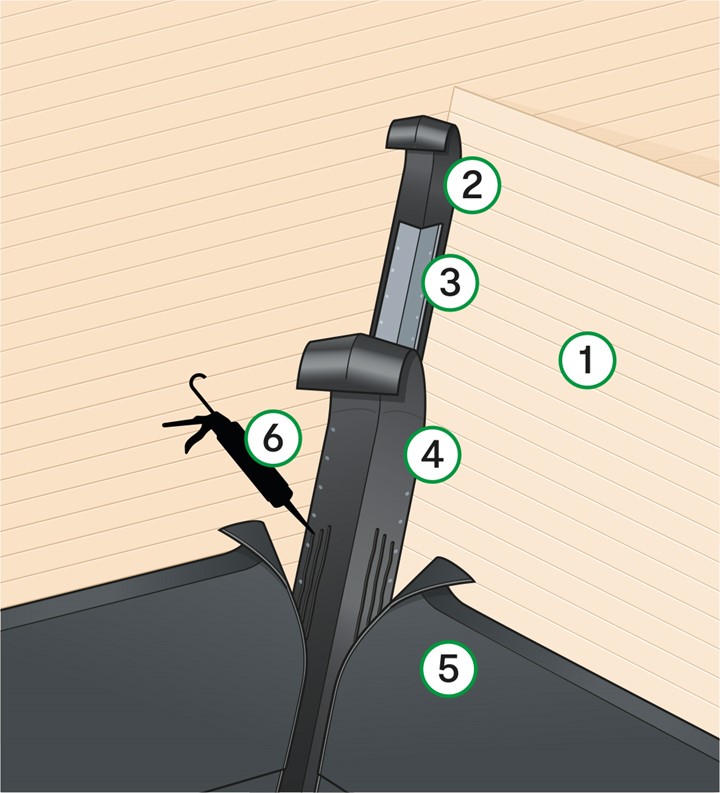
1. Wooden base
2. T-Roof Multi Strip
3. Flashing metal
4. T-Roof Multi Strip
5. Underlayment
6. T-Fix or Sealant K-36
6. Montering som nockremsa (500 mm bredd) över taknock
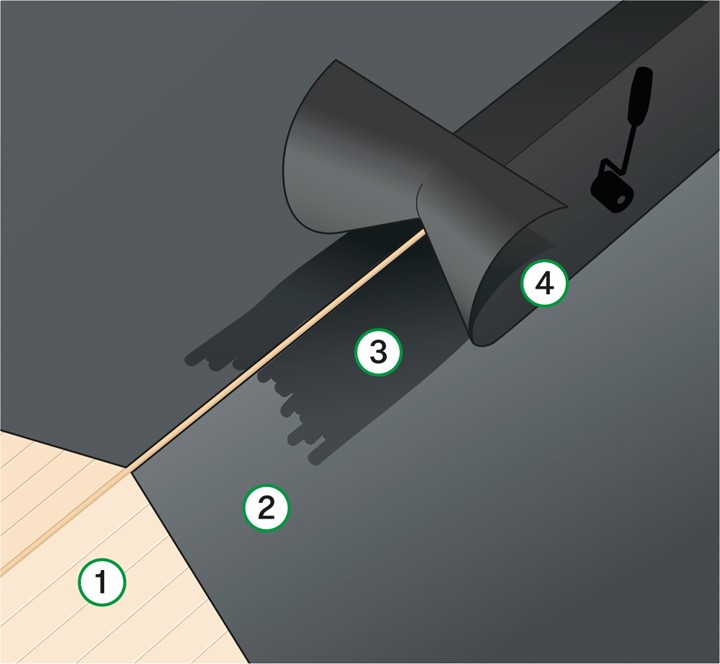
1. Wooden base
2. Underlay covering
3. Primer K-80
4. T-Roof Multi Strip
The underlay covering (2.) should be cut, finished, and mechanically fastened at the top and along the ridge from both sides. On underlay coverings made of underlay fabric, pre-treatment with Primer K-80 (3.) as described above can be performed. Alternatively, the primer can be omitted, and a hot air gun can be used with a moderate (careful) amount of heat to optimize the adhesion of the strip's adhesive surfaces. Heating is done with pressure on the top side of the strip. On sanded underlay covering like roofing underlay, the surface is always primed first. The primer can advantageously be moist/sticky during the installation of the strip. Adhesion is improved with curing after pressure during installation.
Roll out T-Roof Multi Strip (4.) with the underside (adhesive) down. Distribute half the width on each side of the roof. The strip can advantageously be folded before installation to half the width with the protective film inward to create a clear top. The protective film is removed when adhering to the substrate (1.). Press firmly (compress, use roller) the strip against the substrate. Make a cut in the top of the strip at the start and end at the gables. These cuts are necessary to be able to fold out the strip on both sides of the roof at the final triangular list. The cut should be sealed and a piece of Roofseal-T tape is advantageously used.