T-Roof YAP 2200
Fastening occurs at the overlap mechanically in the lower sheet alternatively open and visible through both sheets with roofing felt nails dim 25x2.5 mm. Overlap occurs with adhesive edge against adhesive edge and for any cross joint or similar with approved roofing felt adhesive. Consider the weather conditions when installing adhesive edges. Warm the rolls in a warm storage if the temperature is below +10°C.
Important!
Unless otherwise stated here, the latest recommendations in AMA Hus (JSB.6) apply.
- The permanent surface layer determines the minimum roof slope for the underlay, but always at least 1.5° (~1:40)
exposed but not battened roof. When battening and exposing without outer roofing, at least 14° (1:4)!
If battens are needed for slopes under 14° (1:4), they should be installed immediately after the installation of the outer roof. - For open and visible fastening, consider roof slopes <14° (<1:4) as the roofing underlay may be exposed to precipitation and/or if the outer roofing is not installed directly. Apply the nailing with Sealant K-36 or equivalent repair compound for bitumen waterproofing.
- When covering with flat roof tiles, the supplier's guidelines for the roofing underlay must be followed!
For unsealed roof tiles or in wind-exposed areas (coastal), it is recommended to choose safer options
underlay fabric such as T-Roof Epic. - The roofing underlay should not be combined with surface layers that are hot air mounted (welded).
- For concealed fastening, carefully check the strength of the joint after installation. Consider adverse weather conditions and ensure any temporary securing of overlaps or protective covering until the permanent surface layer is installed!
- The adhesive edge has aggressive adhesion under normal conditions! In cooler weather (<+10°C) it can
Sometimes there is a need to improve adhesion. Use a heat gun and gently warm the adhesive surfaces. Press the joint carefully! In cool weather, rolls should be pre-stored for at least 1 day in a warm storage. - Be mindful to gently load the surface and immediately repair any damage with sealing tape
roof Roofseal-T, roofing felt adhesive Sealant K-36 or equivalent repair compound for bitumen waterproofing. In case of major damage, use and attach/glue a strip from the roofing underlay. - Mechanical fastening should be hot-dip galvanized roofing felt nails, minimum 25x2.5 mm.
- Always cover with the surface layer (tiles, sheet metal, etc.) as soon as possible to avoid impact from
sunlight and adverse weather conditions. During the construction period, the roofing underlay can be exposed to sunlight for a maximum of three months. In the operational stage, the underlay should be protected by the outer roof covering. - Rolls should be stored upright on a flat, dry surface and protected from sun and precipitation.
- T-Roof YAP 2200 is diffusion-tight and when mounted on a wooden substrate, the space underneath should be ventilated according to standard practice.
1. Installation
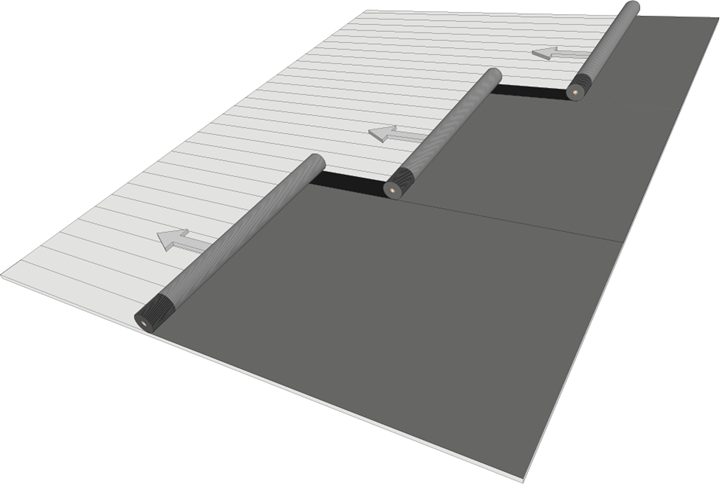
Installation is done with strips across the direction of the roof slope. Rolling is done from right to left so that the side inside the roll becomes the top side when unrolled. The strips are easiest laid from the bottom with overlapping subsequent upwards. The substrate should be dry, even, and stable to avoid deflection and movement. The surface layer determines the nature of the substrate and the minimum slope. For the minimum underlying panel thickness, see table AMA HSD. 1331/1 (AMA Hus -21). For battened roofs, at least 20 mm tongue and groove, and for non-battened, at least 23 mm. NOTE! The space under the wooden base or above the insulation must be ventilated according to standard practice.
For roof slopes steeper than 18° (1:3), the underlayment can also be installed according to the roof slope, from ridge to eaves. Be extra careful to ensure the adhesive edges stick during installation.
2. Gables
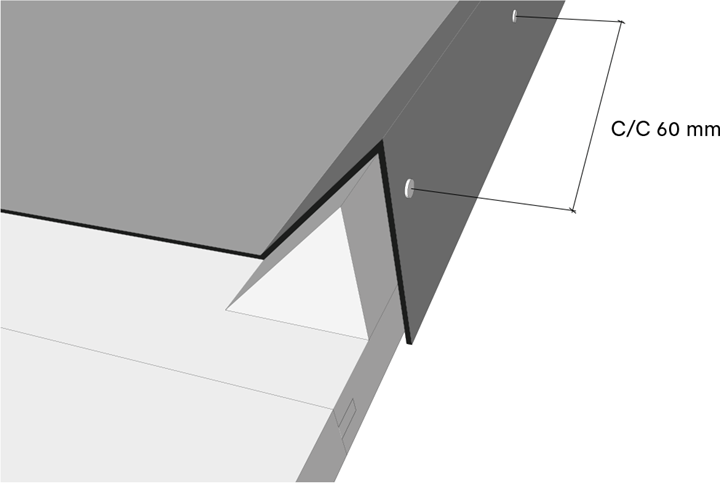
Starting and ending against gables is best done with a triangular strip that angles the base upwards.
The underlay paper is folded around the strip and fastened visibly on the outside.
3. Connectors
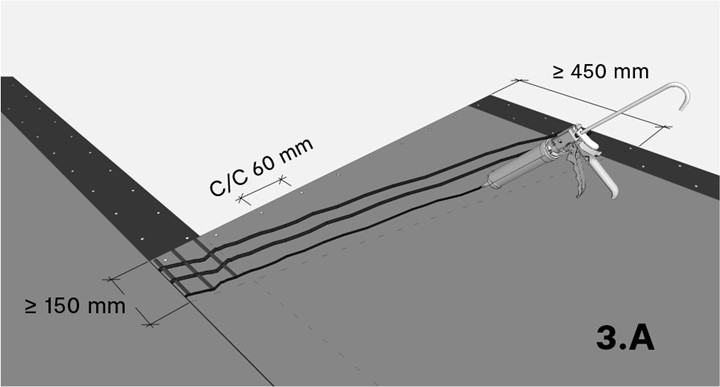
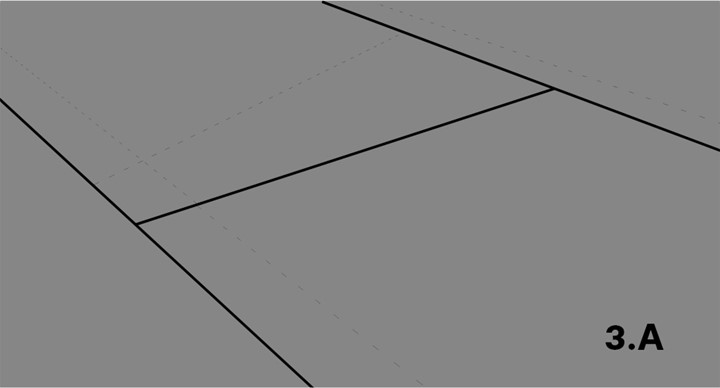
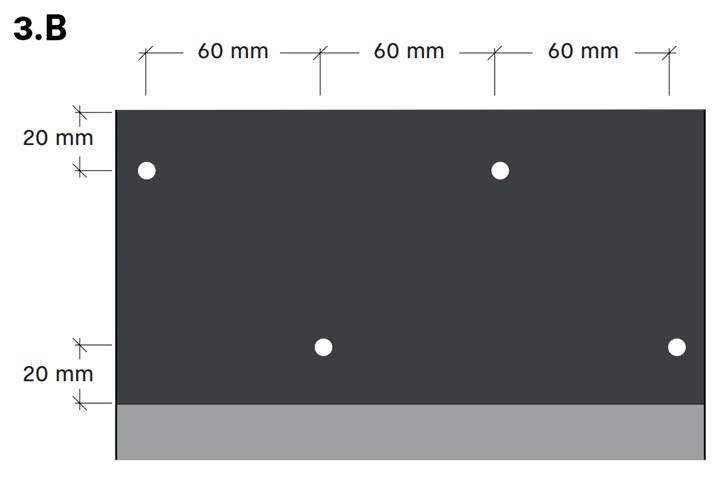
The roofing underlay is mechanically fastened with roofing felt nails min 25 x 2.5 mm (according to fig 3.B) openly and visibly (through both sheets in the overlap) in longitudinal and transverse joints. The sheet is temporarily fastened at the top edge (approx. 1 m between fastenings) and adjusted at the bottom edge. Overlapped in a straight edge line, the protective films are then removed simultaneously with careful pressure afterwards. Overlap occurs with adhesive edge against adhesive edge corresponding to the recommended overlap. Alternatively, mechanical fastening is done hidden in the upper adhesive edge of the sheet. NOTE! In case of hidden fastening, carefully check the strength of the joint afterwards. Consider more difficult weather conditions and ensure any temporary fixing of the overlaps or protective covering until the permanent surface layer is installed! Alternatively, battening if possible! At transverse joints, the overlapping sheet at the lower edge should overlap at least 150 mm and then be cut diagonally upwards so that the overlap at the top becomes like the lower (150 mm) + 300 mm. The lower sheet is fastened at the edge with mechanical fastening center distance 60 mm (according to fig 3.A). Transverse joints should be glued down with 3 strings of roofing felt adhesive corresponding to Sealant K-36 in case of hidden fastening. In open and visible fastening, the overlap is nailed down with roofing felt nails.
4.
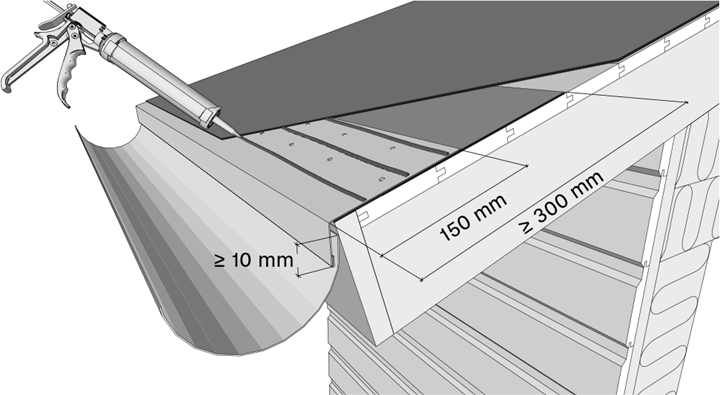
At the eaves, the first strip is attached at the lower edge against the recommended eaves flashing with the adhesive edge
(Do not forget to remove the protective film!) and 3 sticks of roofing felt adhesive equivalent to Sealant K-36 (see fig 4). The end is positioned slightly up (about 20 mm) so that it is concealed by the protective surface layer in the usage environment. Adhesion should be done on cleaned metal. The eaves plate should be mounted on a strip of underlay above the wooden substrate (e.g., T-Roof Multi Strip).
For the surface layer of self-adhesive roofing felt, install the eaves flashing on top of the first layer of the underlayment.
5.
A ventilated ridge is arranged with an end at the wooden substrate's end towards the ventilated opening. Fasten at the top with roofing felt nails. Ensure that the ridge board is covered with an adapted strip of roofing underlay down towards and out onto the top of the counter battens so that it is clamped by the topmost load-bearing batten.
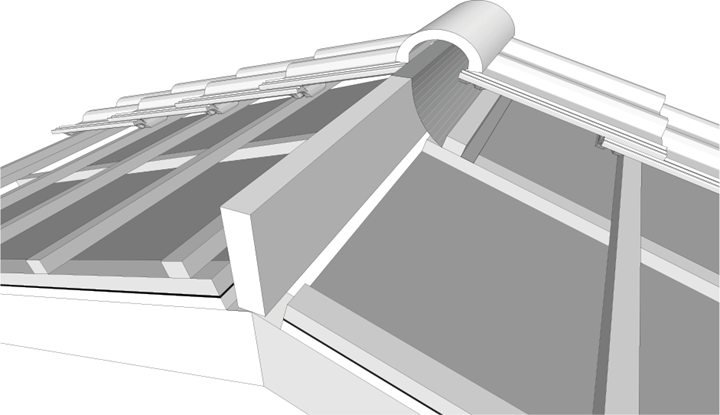
6.
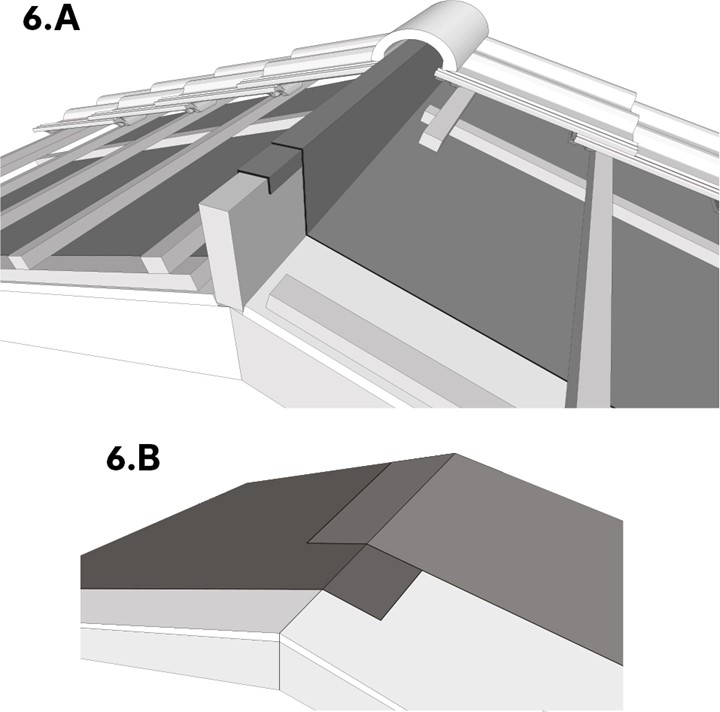
Sealed tight
For a tight ridge, make an attachment against the top edge of the ridge board and over to the other side, fastening mechanically with, for example, roofing felt nails. Covering the ridge board is done from both sides of the roof and also constitutes the overlap of the roofing underlay. If no ridge board is used, the overlap should occur from each side of the roof and total at least 500 mm. The lower sheet is fastened with, for example, roofing felt nails, and the upper is glued down with roofing felt adhesive equivalent to Sealant K-36.
7. Angle gutter
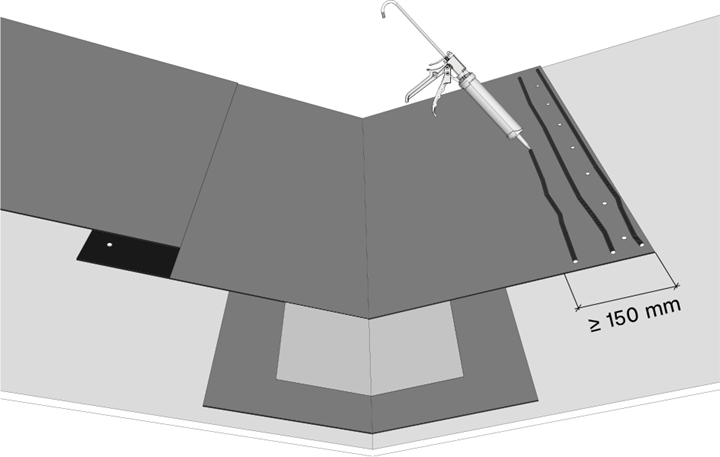
First ensure that the valley gutter has a stable and fixed base with a metal underlay (minimum 300 mm wide). The underlay should be provided with a strip of roofing underlay underneath. The underlay should be nailed to mechanically hold the roof sides together. In a valley gutter with valley flashing, the gutter should be equipped
with a strip of roofing underlay (see fig 7). The strip in the valley is fastened at the ridge and at the outer edges of
for example, roofing felt nails c-dimension 100 mm. Then let the connecting sheets from each roof side overlap the valley sheet by at least 150 mm. The fastening is done with roofing felt adhesive equivalent to Sealant K-36.
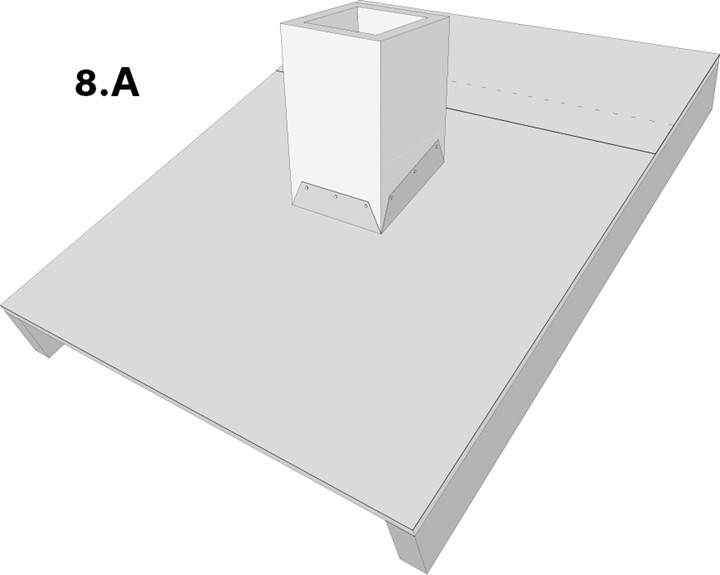
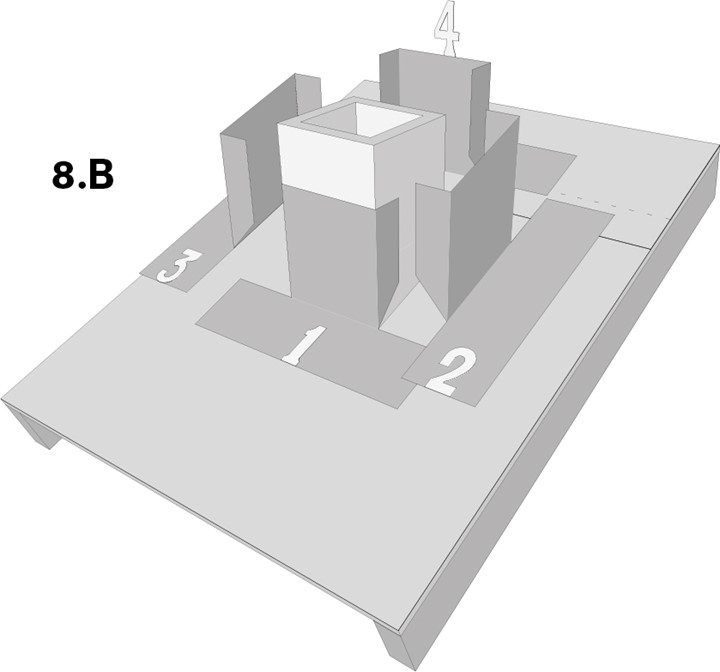
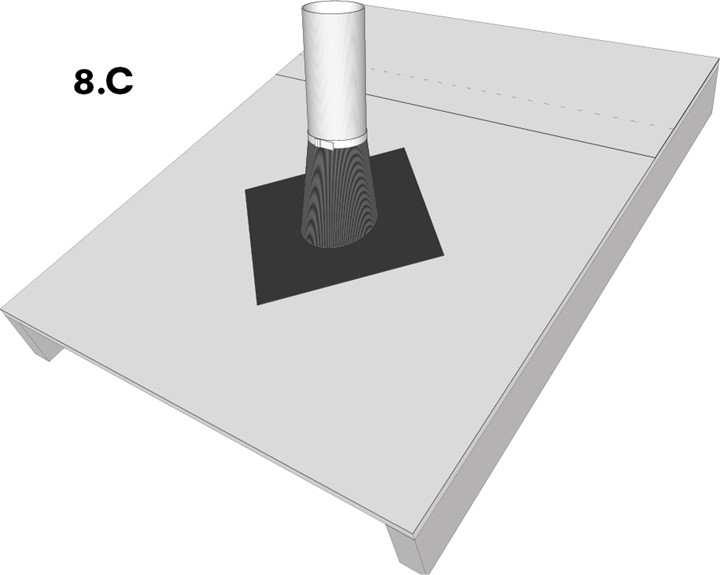
8. Implementation options A, B, and C
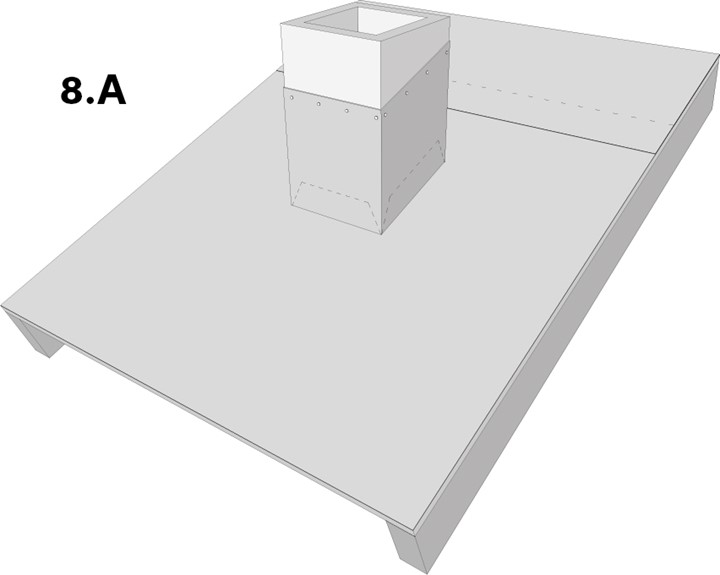
A. For square pass-througs(chimney, ventilation duct, etc.), the underlay should be cut, folded up, and nailed at the bottom (see fig 8.A). Then cover the fold with a strip of roofing underlay all around with an overlap (at least 300 mm high). Fasten with nails and glue (80 mm wide or 3 strings) or nail at the bottom. Nailing is done with a c-measure of at least 100 mm. Gluing is done with Sealant K-36 or equivalent. The corners are sealed extra with Sealant K-36 or equivalent sealant or with elastic durable sealing tape. Pass-throughs in battened constructions are finally provided with an underflashing of metal at the bottom and all around!
B. For square pass-throughs and lower roof slopes (≤12°/1:5), higher safety and installation with glued collars are recommended (see fig 8.B). Cut out four sides from the roofing underlay (overlap 150 mm), trim and attach the bottom one first with the subsequent two sides, and finish with the rear one towards the ridge. Gluing is done on all edges with Sealant K-36 or equivalent (80 mm wide or with 3 strings).
C. For round pass-throughs such as holes for ventilation pipes, etc., a collar like self-adhesive T-Collar butyl or full rubber collar is used (see fig 8.C). The base of the collar is fully adhered to the substrate and the roofing underlay. For full rubber collars, adhesion should be done with Sealant K-36 or equivalent. On a sanded surface and when using a self-adhesive collar, the surface of the substrate should be pre-treated with Primer K-80. For a square base, one of the collar's corners should be positioned straight up towards the ridge during adhesion. The collar should be sealed at the top with a clamping ring or at least 2 turns of durable sealing tape.
9. Vertical connection (wall)
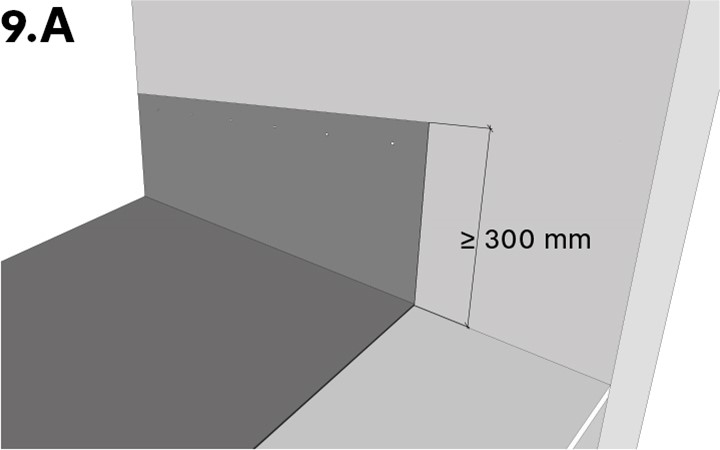
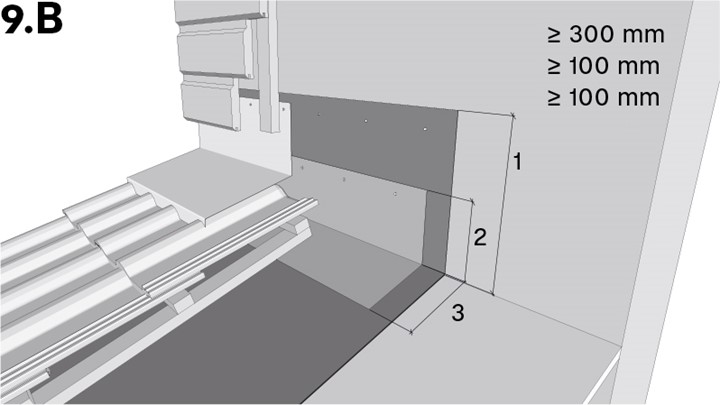
At the connection where the roof underlay at the top edge meets the wall (according to fig 9), an extension on the adjoining wall should be made, at least 300 mm. The extension is made under the facade and attached to the wind protection layer with roofing nails at a c-measure of 100 mm and 30 mm from the edge. For battened outer roofs, the connection is provided with a metal flashing above the roofing underlay.