Important!
- Avoid walking on the carpet to prevent damage and punctures. The top floor should be installed as soon as possible after assembly. Otherwise, temporary protective covering should be done with construction board or similar.
- Follow the assembly instructions carefully. Ensure that the necessary tightness is achieved at the outer edges, joints, or penetrations.
- Use only compatible and recommended accessories.
- The moisture protection mat should be stored before installation to avoid UV radiation (sunlight). Once installed and in use, the entire product should be concealed.
- Note that any potential moisture is not ventilated away with this passive method. If there is uncertainty about the moisture content of the subfloor, a professional should be contacted to perform a moisture assessment and suggest a solution.
1. Fuktspärrsmattan
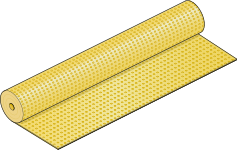
When installing the T-Block Floor, the moisture barrier mat is rolled out with the knobs facing down towards the geotextile.
2. Förarbete
Underlaget och betongytan skall vara tillräckligt jämn. Godkänd tolerans bör vara +/- 3 mm vid 2 m mätt längd. Vid tveksamheter eller avvikelser skall ytan åtgärdas med spackling eller övergjutning.
Additionally, the concrete surface should be cleaned of all organic material such as wood, paper, soil, etc.
3. Accessories
On the concrete surface, geotextile fabric is placed, followed by the installation of T-Block Floor. A suitable fabric is, for example, Tecca Geotextil Geo-T N1. The geotextile fabric is used as a sound-dampening layer between the concrete and the carpet, and it should cover the entire floor area except for the 50 mm closest to the wall.
Butyl sealing tape is used to seal the carpet at the room's outer edges against the substrate, for example, Sealing Tape T-Block Floor.
When installing the T-Block Floor, seal joints, outer edges, and any pass-throughs with T-Flex construction sealing tape to make the system tight. The system is a so-called passive moisture protection system where underlying moisture should be isolated.
On top of the pre-installed moisture barrier system, any flooring can be laid. As an intermediate layer or for extra soundproofing, floor paper or floor foam can be laid before the surface layer of wood and laminate.
For optimal stability, a minimum thickness of the surface layer is recommended (see below). For thinner surface layers of wood or laminate, supplement with a floorboard of suitable additional thickness beneath the surface layer.
Lamell-/ Parkettgolv: 14 mm för bostäder och 22 mm för offentligt
Floor chipboard: 12 mm for residential and 18 mm for public
Layer of reinforced topping concrete: 60 mm
Layer of reinforced floor screed: 20 mm
4. Installation
Anslutning vid ytterkanter
Före läggning stryks underlaget/ betongen med lämplig golv-/betongprimer för invändigt bruk, i ett ca 50 mm brett band runt om fasta avgränsningar som väggar och socklar (fast inredning). Strykningen görs tätt mot väggen eller sockeln.
The application is done on a dry and clean concrete surface and in double layers. After the necessary drying time, the coating forms an adhesive base for the moisture barrier's edge sealing and sealing tape.
Roll out geotextile fabric over the entire surface and finish approximately 50 mm from the wall/fixed furnishings like the primed area.
Rulla ut fuktspärrsmattan ner mot underlaget och skär till mot vägg utan uppvik!
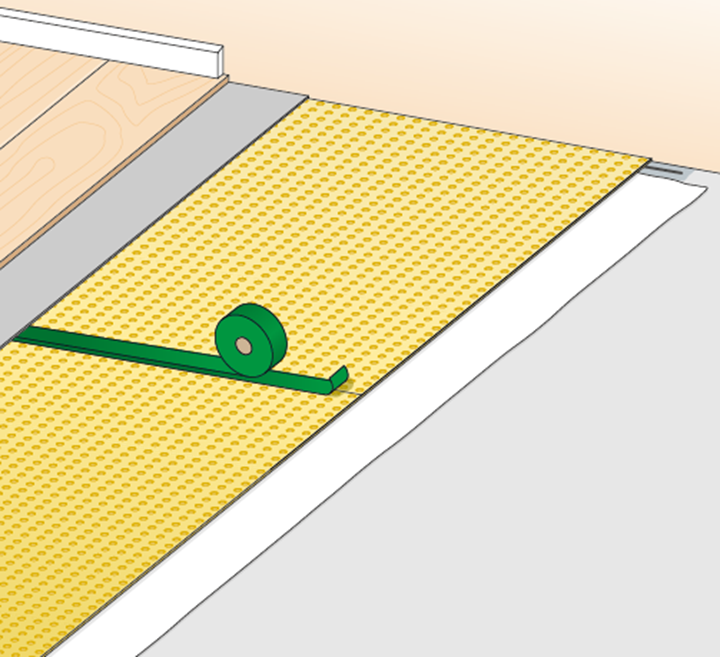
Attach Sealing Tape T-Block Floor under the first and second knob of the moisture barrier mat at the outer edges, against the wall or baseboard. Press the mat down evenly and firmly so that the tape adheres and seals against the primed surface.
The sealing tape should seal around the outer edges when the entire floor surface is covered with a moisture protection mat.
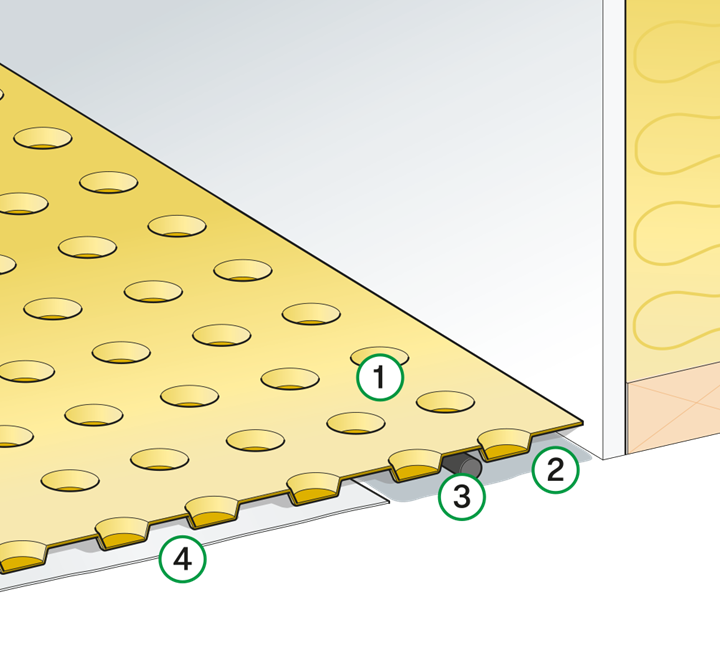
1. Moisture barrier mat
2. Primer (approx. 50 mm)
3. Sealing Tape T-Block Floor
4. Geotextilduk Geo-T N1
Seaming
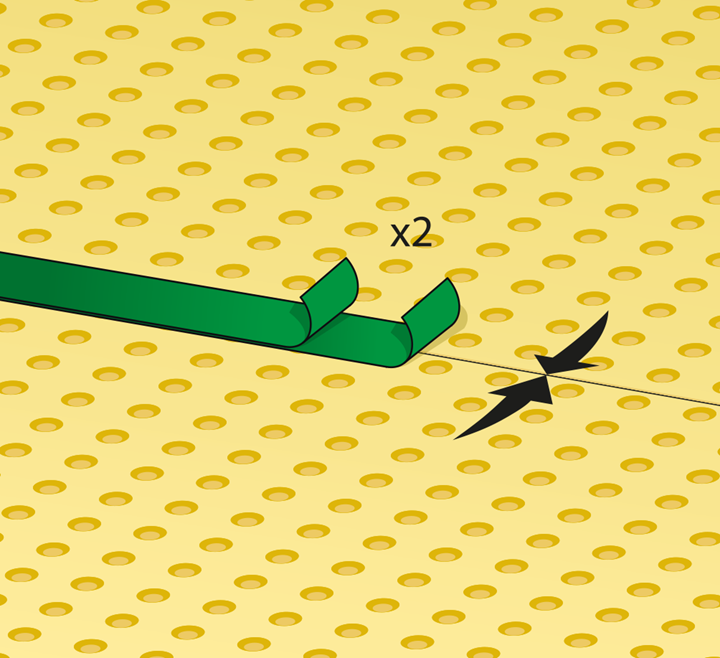
Roll out the next strip of T-Block Floor tightly edge to edge (do not overlap) and seal the seam with T-Flex construction sealing tape. The tape is applied in double layers for the required tightness. Once the entire room is laid, the surface layer/flooring material is installed.
5. Genomföringar
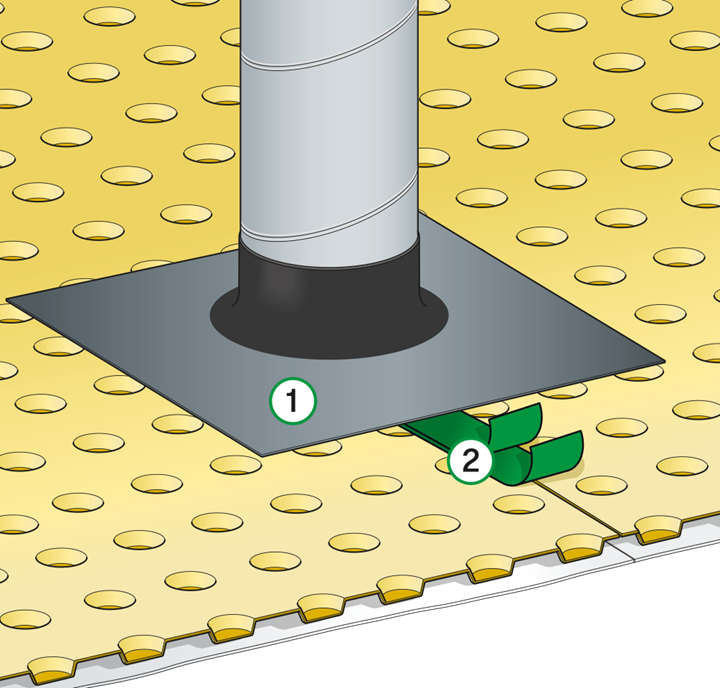
For round pass-throughs, it is important to ensure proper sealing, which is best achieved with T-Stos of the correct dimension. The Stos is adhered to the top side of the mat with the self-adhesive butyl collar (foot).
Cut out a centered hole for the pass-through/pipe in the mat. For existing pipes or channels, it is easier if a cut is made in the mat to the nearest edge. This seam is taped with two layers of T-Flex tape from the start of the hole to the edge of the mat.
The sleeve is glued down to the mat so that it overlaps the taping. The top of the sleeve (rubber collar) is additionally sealed at the top with two turns of T-Flex against the pipe.