Important!
- Details such as overlap joints, fastenings, pipe and cable pass-throughs, or for example beams, should be sealed airtight with approved aids for the inner climate shield system, such as tape, collars, sealant, or double-sided tape. See system description!
- Mechanical fastening (staples/nails) of the foil (safety fabric) must always be galvanized. Fastening with staples should be taped (with T-Flex) for optimal airtightness.
- Connections/seals of the foil between different types of construction materials, where the foil is attached as
for example, between wood and concrete or steel/sheet metal, should be done with extra foil in folds/waves just before the connection (approximately 50 mm)
- Folds in the foil that meet taped joints across should be sealed extra with at least 200 mm taping over them
taped the overlaps and along the fold (100 mm in each direction). This extra taping should follow the bottom and top of the fold! - During installation and colder seasons, consider the risk of condensation on the inside of the external wind barrier. The installation of the foil (safety fabric) should be done immediately after the installation of the wind barrier and insulation.
- In the roll, a joint may occur marked with tape. This joint is not approved, and a new jointing should be performed according to this installation instruction! The roll is then compensated with an extra 1.5m of fabric.
- Store and keep packaged/protected from sunlight (UV radiation) or constantly higher temperatures (>+35°C). The film (safety fabric) has freely exposed (not built-in) UV protection that corresponds to the construction time (< 6 months).
Installation
The foil (safety mesh) is generally attached to the underside of the roof beams with galvanized staples and with a drop around (200 mm) towards the walls. A sparse panel of at least 28 x 70 mm (c-distance max 400mm) from below secures and fastens the foil definitively to the roof beams. All seams must be taped!
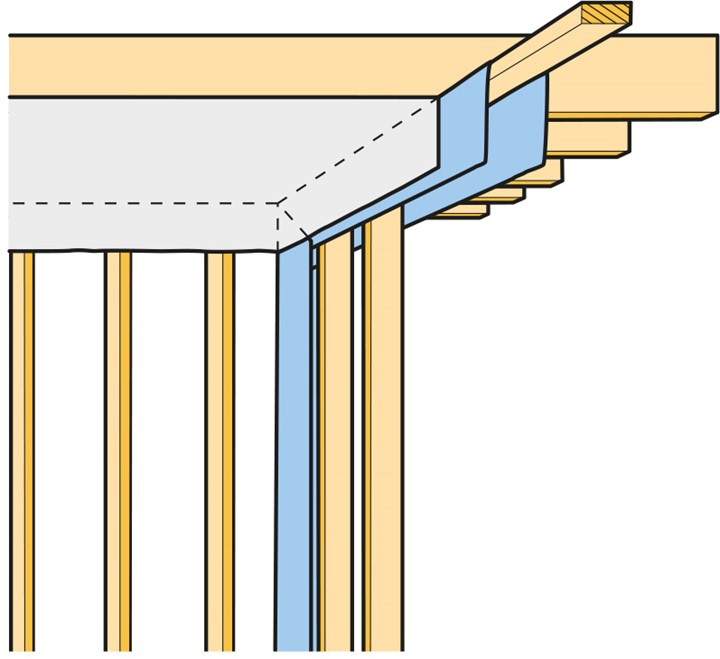
Sealing at load-bearing interior wall
The tightness improves if interior walls are erected in connection with the above assembly with a strip of vapor barrier placed between the floor structure and the interior wall.
Cross joint and underlying insulation
Where cross joints are necessary, execute them well. Joints and overlaps may only occur over the roof truss/beam with an extra 100 mm flap on each side of the truss. Fold down the lower flap and fasten
against the beam with hot-dip galvanized roofing felt nails at least 20 x 2.8 mm and c-distance 80 mm. The upper sheet is clamped at the overlap of the counter battens according to item 1 (Start assembly). Over the truss and between the sheets, T-Butyl Joint Tape is placed as a seal!
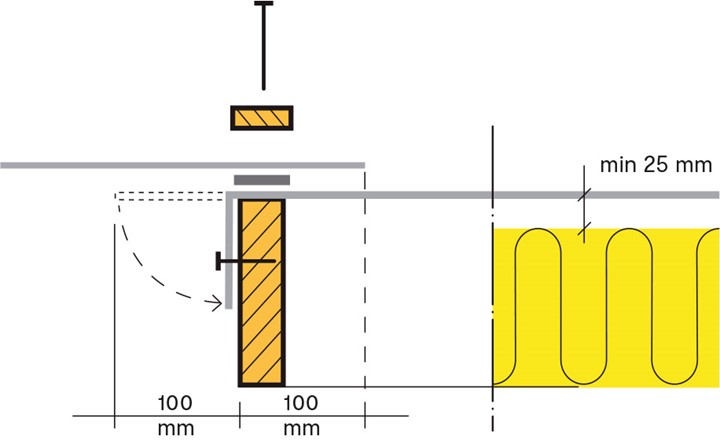
Along the roof beams
1. Roll out the foil and cut to the desired length. Always allow for at least 200mm overlap. Start from
that 200 mm should be folded down on exterior walls and connected.
2. Start at the wall and attach and roll the foil in the same direction as the beams. The overlap and joint to the next foil sheet should occur under the beams (200 mm). The overlap joint should be stretched completely along the beam and clamped across with a sparse panel at least 28 x 70 mm, which is nailed with
2 pcs wire nails 100 x 3.4 mm in each beam (c-distance max 400 mm between each sparse panel). At most every other sparse panel may be joined in the same truss (2 + 2 nails in each joint). Sealing of the joint should be done with Sealing Tape T-Flex.
3. Insulation is placed tightly on top of the foil and between the roof beams so that no unnecessary air spaces are formed.
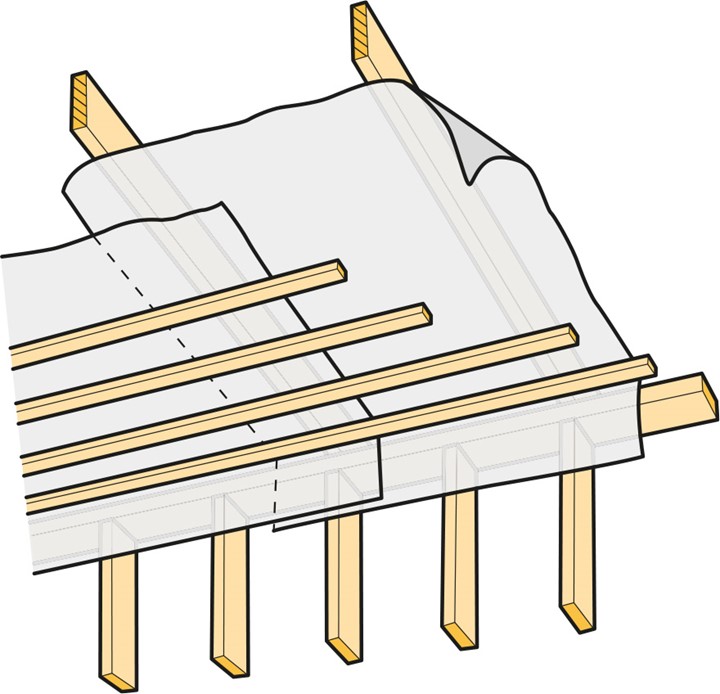
Across the roof beams
1. Roll out the foil and cut to the desired length. Always allow for at least 200 mm overlap. Assume that 200 mm should be folded down on exterior walls.
2. Start at the wall and attach and roll the foil across the roof beams. The overlap and joint to the next foil sheet should occur under the beams (200 mm). The overlap joint (at least 800 mm) should be fully stretched and clamped with battens at least 28 x 70 mm (2 pieces) nailed with 2 wire nails 100 x 3.4 mm in each beam and the center of the overlap. A maximum of every other batten may be joined in the same truss (2 + 2 nails in each joint). Taping of the joint should be done with Sealing Tape T-Flex and with extra battens fastened/clamped along the entire joint taping.
3. For sparse panel c-distance 400 mm, the sheets must overlap at least 800 mm. For alternative sparse panel c-distance 300 mm, the sheets must overlap at least 600 mm.
4. Insulation is placed tightly on top of the foil and between the roof beams so that no unnecessary air gaps are formed.
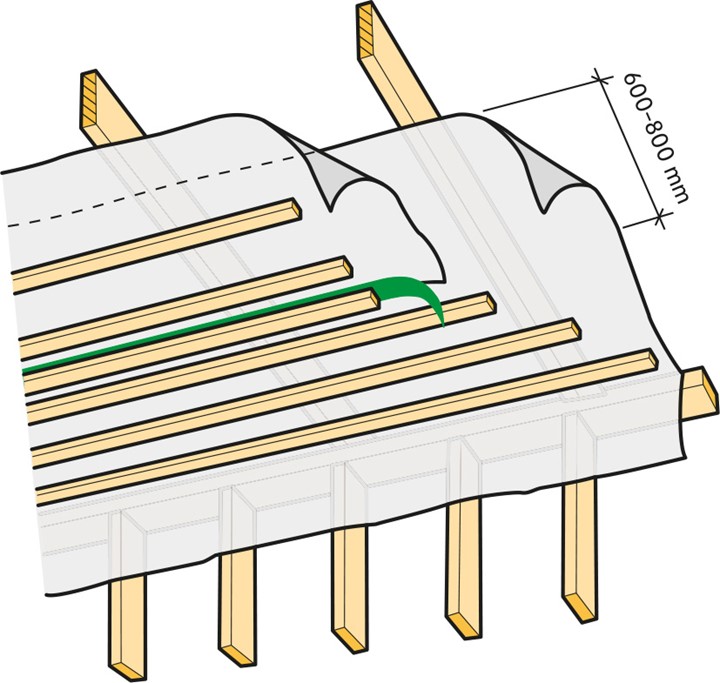
1. Start assembly
Coverage is done horizontally starting at the eaves. First, attach custom wedges to the ends of the rafters. Then, an eaves board (Construction Plywood or clapboard wood panel wood) with a drip edge above and as a drip edge (with a drip edge strip underneath). The height of the wedge and the thickness of the eaves board should together correspond to the thickness of the battens and a roof tile. The eaves board should be wide enough to reach about 10 mm below the lowest batten and edge. Thereafter, any
gutter hooks. The underlay should be rolled out with the printed side facing up, stretched well about 20 mm from the bending edge of the base plate. Attach sparingly but as needed with staples (12.9 x 10 mm, c-distance 50 mm or 16.5 x 19 mm, c-distance 100 mm) to the roof truss. Cut manageable lengths for handling on the roof and add an extra +100 mm at each gable truss. The bottom edge of the sheet is fastened down to the base plate with double-sided T-Butyl Joint Tape. The underlay is fixed by shorter battens (min 22 x 45 mm) and with an end before the marked chosen overlap or marked line for overlap. Lengths according to the battens. Then fasten the battens over the underlay to the roof truss with hot-dip galvanized wire nails 63 x 2.8 mm c-distance 300 mm. The load-bearing battens (min 45 x 70 mm) are then fastened with 2 x hot-dip galvanized nails 100 x 3.4 mm at each roof truss attachment point.
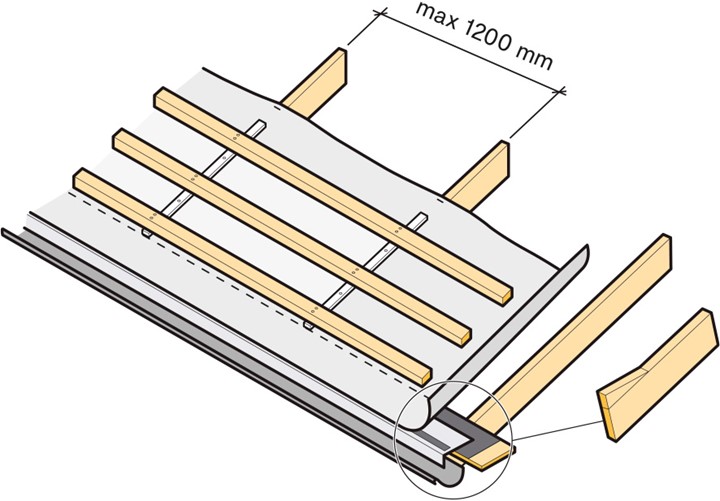
2. Subsequent panels
Roll out the next sheet with overlap adjusted to the chosen overlap. Measure down from the lower sheet's
top edge. At 14°– 26° slope, a total overlap of 200 mm and at ≥27° slope, the minimum overlap is 150 mm. Adjust the sheet evenly and attach it to the rafter with staples. Ensure that the overlapping sheet follows the slight sag of the lower one between the rafters. Complete the stapling. Further fixation to the rafter is done with battens (up to the next line for overlap).
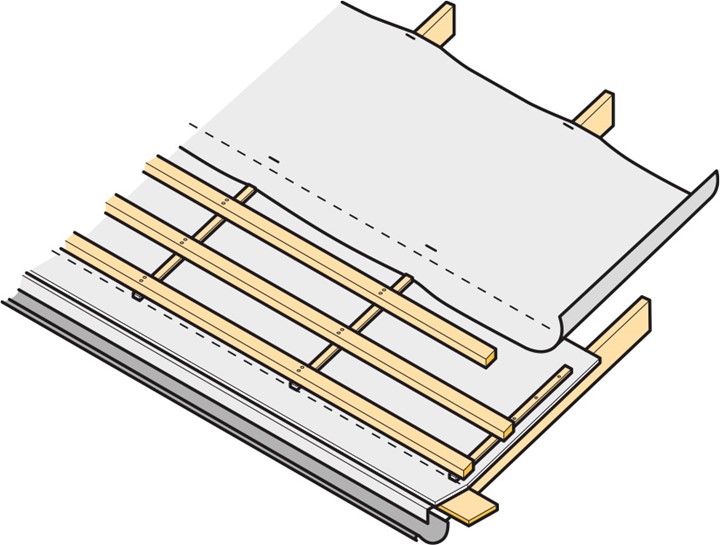
3. Transverse joint and underlying insulation
Where cross joints are necessary, execute them well. Joints and overlaps should only occur over the roof truss/beam with an extra 100 mm flap on each side of the truss. Fold down the lower flap and fasten it to the beam with hot-dip galvanized roofing nails at least 20 x 2.8 mm and a spacing of 80 mm. The upper flap is clamped at the overlap of the battens according to point 1 (Start installation). Over the truss and between the sheets, place T-Butyl Joint Tape as sealing!
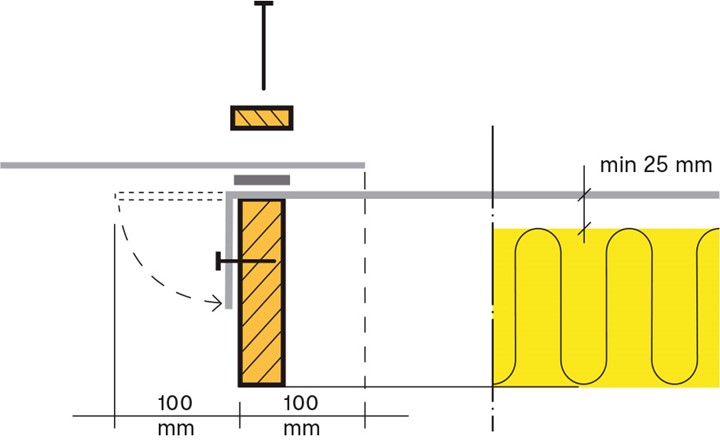
1. 4. End
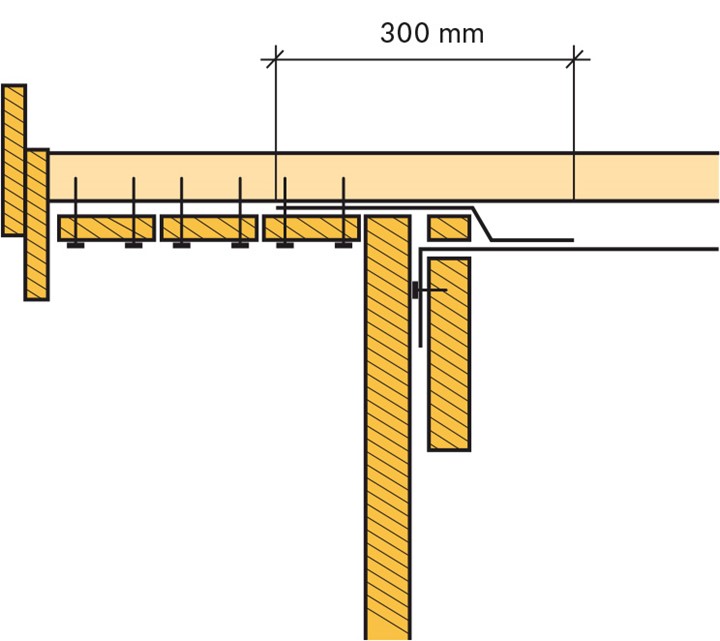
The flap edges (100 mm) at the gable truss are folded down on the outside and fastened with hot-dip galvanized roofing felt nails at least 20 x 2.8 mm and c-spacing 80 mm. As a protective transition between the gable peak and the underlay roof, a strip of the same material (approximately 300 mm) is installed. The strip should be drawn from and over the nearest lower cladding board on the gable peak at least over the underlay roof by 200 mm.
5. Nock
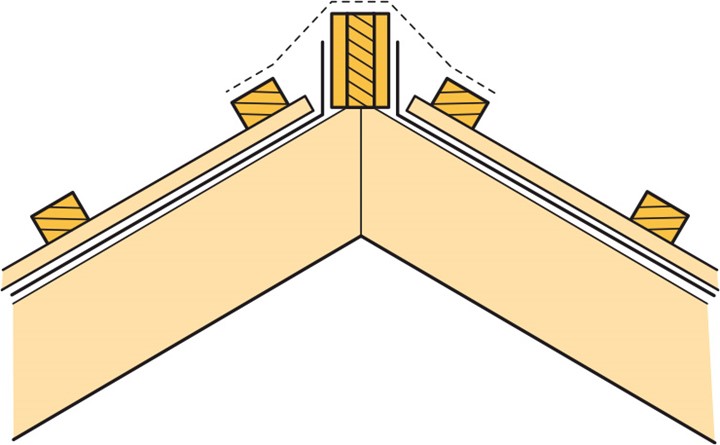
The cam should be mounted open for ventilation. Spacer blocks (25 mm thick, 95 mm wide) are attached
on each side of the ridge board with a c-distance of 600 mm. The height of the blocks should be adjusted according to the shape of the overlying ridge tile. They can be placed slightly lower than the top of the ridge board. The underlay is pulled up on each side against the blocks (ending 20 mm from the top of the block) and fastened with hot-dip galvanized roofing felt nails (20 x 2.8 mm). Ensure that the underlay is stretched between the blocks! Finally, the ridge is equipped with a ridge seal/ridge band (according to the dashed line). In the case of a cold attic, a tight ridge installation can be performed (not shown). Then the sheets at the ridge should cover both sides of the ridge board and be finally fastened with hot-dip galvanized roofing felt nails at least 20 x 2.8 mm, c-distance 160 mm. The ventilation under the underlay must not be impaired, and high-placed gable vents must be used or alternative equivalent openings such as roof vents (hoods).
6. Task against facade
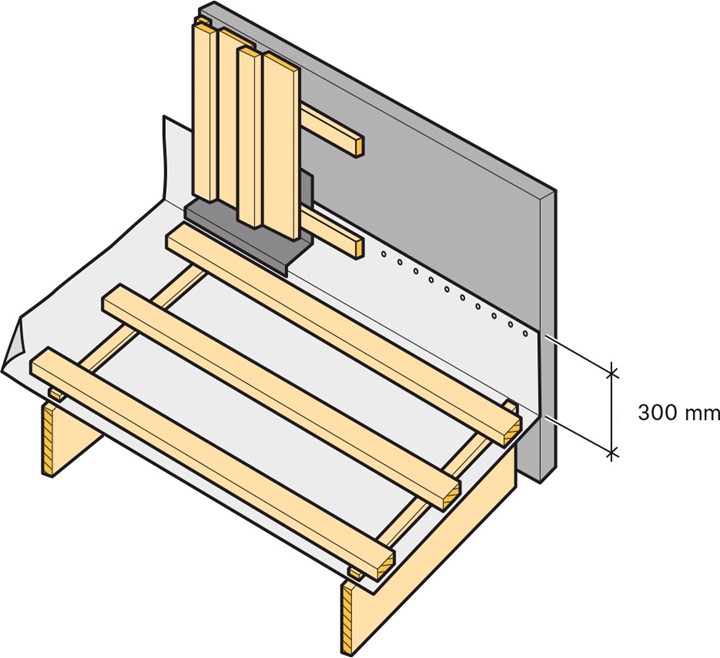
The underlay is pulled up at least 300 mm and fastened with hot-dip galvanized roofing felt nails at least 20 x 2.8 mm, c-spacing 80 mm.
7 & 8. Implementation larger
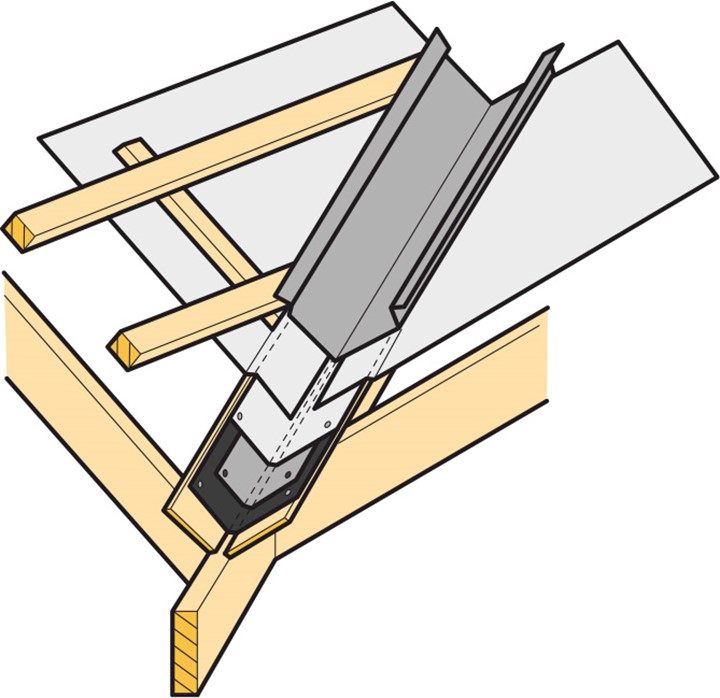
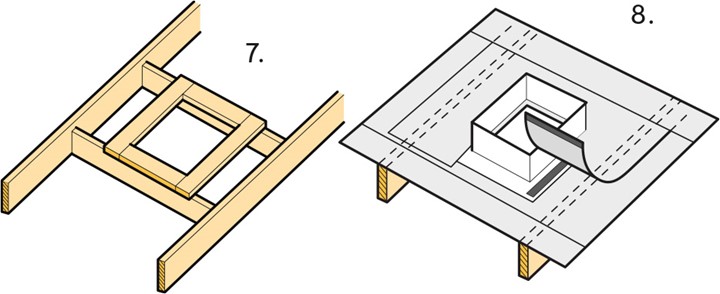
Pass-throughs like skylights or chimneys first require trimmers between the roof beams for support and stabilization. Additionally, a sub-flashing with a 150 mm wide collar/foot is required. Install the underlay over and mark the location of the installation. An extra sheet length is laid over the entire roof truss section. The sheet is slid under the upper overlapping sheet. It is easily fastened under the overlap and sealed afterwards if necessary. Fold up the extra sheet and arrange the installation in the lower sheet. Install the sub-flashing. Cut a flap in the extra overlapping sheet from the top edge of the sub-flashing and tightly straight down on both sides. Fold down. Secure this overlapping sheet with the upcoming battens and double-sided T-Butyl Joint Tape at unfixed edges down to the substrate.
1. 9. Implementation minor
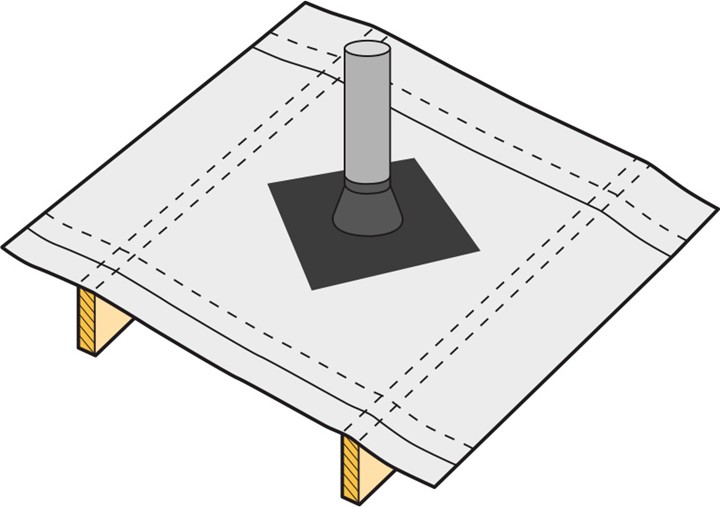
Pass-throughs such as smaller round air ducts (drains, etc.) are made with self-adhesive collars (T-Collars) in the correct dimension. Mark the center of the hole and make a slightly smaller cross-cut in the underlay than the pipe diameter. The rubber sleeve should be slipped over the pipe and the adhesive collar pressed firmly against the substrate with one corner angled up towards the ridge.
10. Valley gutter
The valley gutter should have a stable base of construction plywood and for optimal fixation, an underlay of metal. The underlay should also be equipped with a strip of T-Roof Multi Strip/YEP2500 on the underside. A strip of the underlayment is then placed above the underlay, covering the entire width of the base and the underlayment, as well as its entire length. Allow each roof side's sheets to be drawn over this central sheet with overlap towards the middle. Secure with double-sided T-Butyl Joint Tape along the entire length of the joint. Finally, install the gutter plate over it. Finish down towards the foot plate as previously described.